
Behind the Yield
A Year After the Cockroach
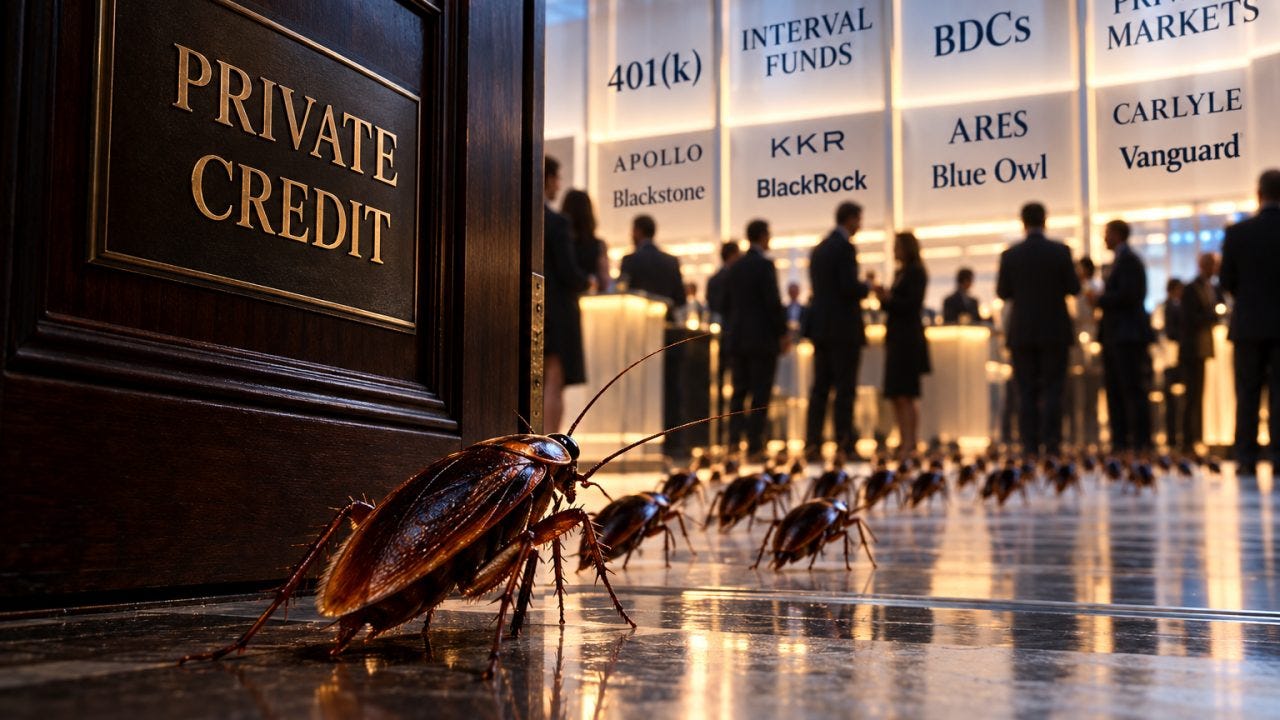
A year ago this week, Jamie Dimon said the quiet part out loud. It was JPMorgan's third quarter call and it didn't sound scripted.
“I probably shouldn't say this, but when you see one cockroach, there are probably more.”
He was referring to two. Tricolor was a subprime auto lender that caused a $170 million loss to JPMorgan. First Brands, the auto parts company, went bankrupt after borrowing more than $10 billion.
JPMorgan will report again tomorrow morning (data at 7, Dimon on the phone at 8:30). I don’t know what he will have to say. But I am fairly confident about what the industry did with his comment. They ignored it.
I won’t rehash the losses or the gates. Let’s instead focus on what came after the comment.
MORE FUNDS
There were 304 interval and tender offer funds two weeks before the call.
By this August there were 335.
Money in those funds increased from $252 billion to $303 billion by the middle of this year.
There was a record number of fund launches last year. 67 funds were launched.
28 new funds were launched through the end of August this year. In the same year, non-traded BDCs saw their first quarter in which more money was outflowing than inflow. In the first quarter of 2026, they raised $4.9 billion and paid out $6.9 billion.
There are 50 more funds waiting at the SEC. 26 of these are with managers who have not run one before.
When I was younger this would have been a crowded market. Now I see it as late. Those who were early in the market are lining up at the door. New entrants are walking in after them.
Bain Capital’s non-traded BDC filed in April to increase its selling amount to $3 billion. At the time, non-traded BDC sales were down 59%. (The managing dealer is Emerson Equity. Longtime readers should recognize that.)
Public BDCs trade at approximately 82% of NAV according to Raymond James. Private BDCs go in and out at 100. They have similar loans and often the same manager.
THE PEOPLE SELLING IT
I find this section to be humorous.
Executives in the industry have already admitted a problem. Doug Ostrover at Blue Owl said, “I don’t think we made it clear enough.” John Waldron at Goldman said, “It’s really illiquid.” Apollo’s Jim Zelter said, “I don’t think it was a one-shot.”
The selling has continued.
JPMorgan marked down a significant amount of its private credit loans in March. These loans were mainly in the software sector. Since the spring the New York Fed has been visiting JPMorgan, Wells Fargo, Barclays and Morgan Stanley regarding these loans. JPMorgan, Goldman and Bank of America are also offering a basket of stocks that may be used to bet either for private credit or against it. Either way the banks get paid. This does not surprise me from having been on Wall Street for this long.
THE BIG NAMES
Fidelity launched model portfolios in March that include private credit, private equity and private real estate. There is a $100,000 minimum and a CE program for advisors.
In July, Vanguard launched funds in the private markets with Blackstone and Wellington. Vanguard! I read that twice. Merrill is selling these funds now.
In September DTCC (which is the plumbing behind the public markets) bought into iCapital. DTCC's companies processed $4.7 quadrillion in transactions last year. Now DTCC has a seat on iCapital’s board as an observer. DTCC’s Talia Klein described the transaction as follows, “Private markets have traditionally lacked the operational standards that exist in public markets.”
I agree with her. I always assumed that is why there has been a need to slow down.
iCapital had $300.6 billion in alternatives on its platform in January and $327 billion at its September announcement. The number of finance professionals using the platform increased from 123,000 to 144,000.
In the spring iCapital held its U.S. conference in Phoenix. The conference was invitation only. Platinum sponsors included Apollo, Ares, Blue Owl, BlackRock, Brookfield, Carlyle and Hamilton Lane. The next phase of private credit was also on the agenda. I would have liked to have attended that session also. I suspect no one mentioned the cockroach.
THE 401(K)
All of the above is for people who have money. The 401(k) is where the action is.
In March, the Labor Department released a proposed safe harbor for plan sponsors who are adding alternatives. In July, Deloitte projected that private assets in DC plans could exceed $1 trillion by 2030. In September Great Gray selected iCapital to build funds in private credit, private equity and real assets for 401(k) plans. According to Great Gray’s CEO, these funds should be ready by the end of this year or the beginning of next year.
He said to an interviewer, “We needed an intermediary, not a single manager.” He also said, “It’s been a while, and it’s complicated.”
That is certainly true. Managers own a piece of iCapital. BlackRock, Blackstone, Apollo, KKR and Carlyle are all investors. I have written about this before and I will write about it again. I am not accusing anyone of anything. I am reading an org chart.
THE SEC’S WEEK
I couldn’t have come up with this section.
On Monday, September 28 the SEC released a statement regarding valuation of private assets. Use today’s liquidity and today’s spreads. Use what a buyer would pay today. Do not use the valuation from the date of loan origination.
One week later Semafor released an article on the largest privately held janitorial company in the country. Their loans range from almost 100 cents to about 10. The equity has no value. One company is in a 90 point range. Even the janitor's loans can't agree on a price.
On Wednesday, September 30 the SEC proposed allowing advisers to registered funds and BDCs to charge performance fees of up to 20% on appreciation and gains for funds that are available to more than qualified clients. Skadden reviewed the proposal and said it also includes unrealized gains.
In a private credit fund an unrealized gain is a mark.
So on Monday there was “be careful with your marks.” On Wednesday there was “how to get paid on those marks.”
The same proposal also changes the interval fund rules. A monthly repurchase option would be new. This would be good for investors. Other provisions are not. A new fund could wait two years until its first repurchase offer. Currently a quarterly fund has six months to make its first one. Deferred sales loads could also be taken out of redemption funds. Currently the only deduction allowed is a repurchase fee of up to 2%. The exit fee would come out of the exit.
Another question was asked regarding whether a CFP or a CFA would be sufficient to make someone an accredited investor. I hold a CFA charter. There appears to be a room in the nest for me.
WHAT I’D LIKE TO HAVE ANSWERED
Dimon was correct. What surprised me was how quickly the industry built around the problem and that it built right into the 401(k).
Before this lands on a client’s 401(k) menu, I would like to have four answers. First, who marks the loans and do those marks move with public spreads? Second, who is paid on the mark? Third, how much can exit in a bad quarter and who determines that? And finally who picked the managers and who owns the firm that picked them?
Dimon will speak tomorrow at 8:30. He may not repeat what he said. It is not necessary.
Get Behind the Yield free by email. Short enough to read before your first meeting, specific enough to use in it. Subscribe here.
Need CE hours? Six self-study bond courses, accepted by CFP Board. See the courses.