
Behind the Yield
Bond pipes got better. Toll hasn't.
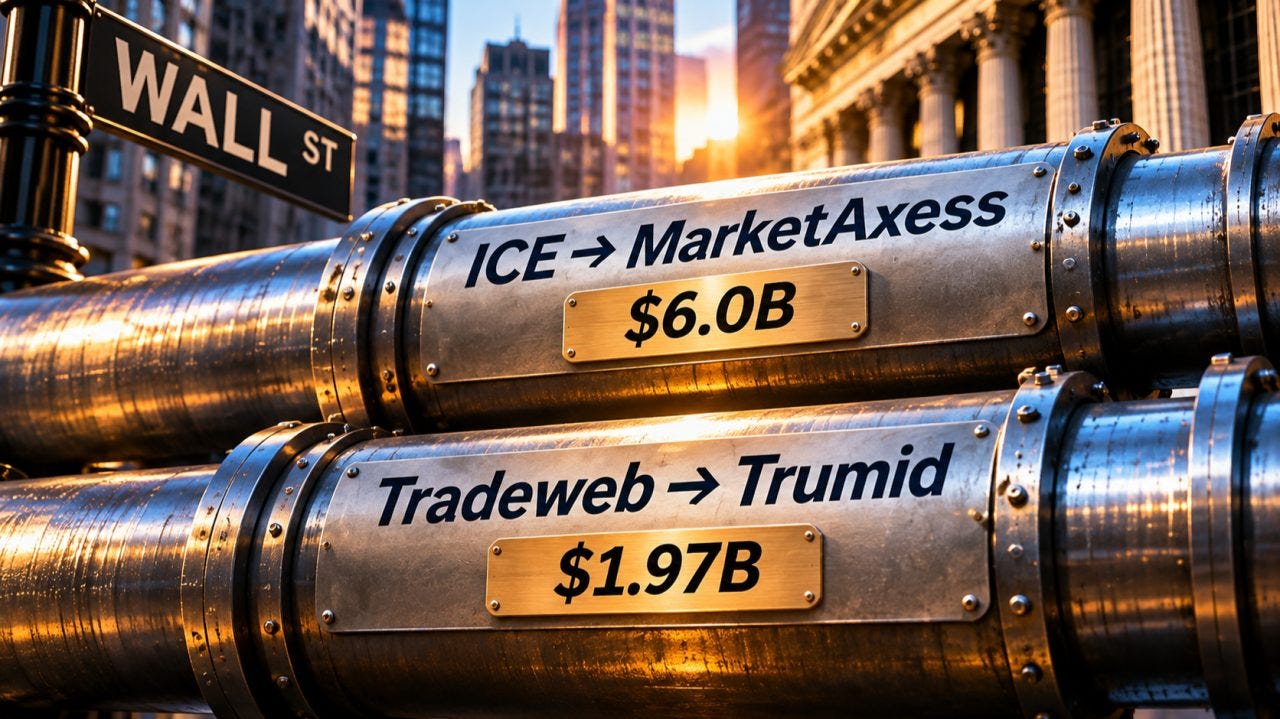
Wall Street is shopping for bond pipes.
In July, ICE agreed to acquire MarketAxess for $167 per share in cash, representing approximately $6 billion in equity value. In October, Tradeweb agreed to acquire Trumid for approximately $1.97 billion.
These are the pipes used for institutional bond trading via electronic platforms. There is a significant value placed on them and that value is correct. I've been watching bonds transition from paper to electronic over more than three decades. Today large funds can trade bonds at a faster pace and at a lower cost than at any time in the past.
Now imagine a $25,000 bond trade for a retiree.
That transaction still has a toll that the larger participants stopped paying many years ago.
THE ONLY MARKET WHERE SMALL PAYS MORE
Buying 100 shares of Apple via a smartphone results in a lower price than when a pension fund purchases a million shares. Commission is zero and the spread is a penny. The little guy beat Wall Street on this over the course of 20 years and won.
In bond markets the numbers are reversed. The smaller the transaction the higher the cost. A retiree purchasing ten bonds pays more per bond than an insurance company buying ten thousand bonds. All of these transactions are of the same bond on the same day. Sometimes even the same hour.
This is not my claim. It's the regulator's data.
Every year the Municipal Securities Rulemaking Board compiles data in this area. Last year, the chief economist at the MSRB, Simon Wu, made the following statement at Brookings. In stocks small transactions are low in cost while in fixed income the opposite is true.
Here is an example of this.
In 2025, the average cost for a small transaction of muni bonds ($100,000 or less) was 50 basis points. A block of $1 million or more cost 21 basis points. Small transactions paid 2.4 times as much.
The same pattern appears with corporate bonds. For January 2023 to June 2024 small transaction costs for corporate bonds were 47 basis points while block transactions were 21 basis points.
For a $25,000 muni transaction a cost of 50 basis points translates into $125. This does not seem like much at first but if the bond yields 3.5% then this represents more than 1.5 months of yield for that transaction.
The type of dealer on the other end of the transaction also matters. The MSRB split 2025's small muni transactions by the type of dealer on the other side. For the types of dealers primarily dealing with institutions the average cost was 33 basis points. For all other dealers the average cost was 88 basis points. This is the same size transaction but the cost is nearly three times higher.
One of the reasons the MSRB cites for this differential is sales credit. In plain English, a salesperson on the retail end of the transaction was paid.
HOW A BLOCK BECOMES A HUNDRED SLICES
I spent 18 years on the retail side of the bond business. Here is how slicing works.
A dealer buys a block at 99, breaks it into slices, sells those to individual investors at 100 and holds the bonds for a few seconds. The dealer takes minimal risk on the transaction and makes a point on each slice.
Recently, a group of academics published the most comprehensive look at slicing I’ve seen. They call the practice smithereening. I did not invent this term.
They found that approximately 10% of transactions involving new muni bonds are sliced within the first 60 days. For bonds that are sliced the markup is 23-26 basis points higher than for bonds that are not sliced. For trades under $25,000 the markup on sliced transactions is 37-49 basis points higher. For larger transactions there is little or no difference in markup.
This is the pattern captured in one study. The smaller the transaction the bigger the markup.
IT USED TO BE WORSE
This point is important and is positive.
Over the 2011-2017 period a group of three finance professors analyzed the muni transaction market. Between 2005 and the early 2010s, the median markup for small muni transactions increased from just under 1% to about 2%. Over a 6.5-year period small investors paid $1.83 billion in markups in excess of 1%.
Then the lights were turned on.
In 2018 dealers were required to disclose the markup on many retail transactions in the confirmation sent to the customer. After this change the smithereening premium decreased. The authors interpret this as a result of disclosure limiting the markup that a dealer can take. I do as well.
The same pattern holds for corporates. An SEC economist and two academics analyzed riskless principal transactions in which a dealer buys a bond and sells the same bond within a minute. The average markup decreased from 87 basis points in 2005 to 39 basis points in 2023. Much of this reduction came from enhancements to electronic trading.
Disclosure and screens also played a role. When the lights were turned on the price came down every time.
THEN WE STOPPED TURNING THE LIGHTS ON
In June 2025, the SEC withdrew 14 pending rules. One of these was Regulation Best Execution. This rule would have defined a broker’s obligation on execution quality and imposed stricter rules on conflicted principal transactions.
At about the same time, the one-minute reporting rule for bond transactions was shelved. The MSRB also did not set an effective date for this rule. FINRA decided to maintain its 15-minute reporting rule. Many in the industry pointed out that one minute was not possible because a large portion of the bond market is not fully automated.
Perhaps this is fair. There is still a large amount of bond trading that is done on phones and spreadsheets. I know this because I worked on those desks.
But what this means is that the same tools that reduced retail costs the last time have also been set aside. In munis the gap between small and block is still 2.4 to 1.
WHAT THE DEALERS SAY
The dealers do have a claim and it should be heard.
Small transactions are more costly to process. Odd lots are more difficult to sell back. A dealer that holds $15,000 of bonds from an obscure school district cannot simply hit a screen and sell them immediately. There has to be a buyer found and that takes time and capital. Years ago, the Securities Litigation and Consulting Group conducted a study on retail transaction markups. At the time the dealer trade group said there was no clear consensus that retail was getting anything but fair prices.
Some of this is true. A transaction of ten bonds is not the same as a transaction of $5 million in bonds.
But this does not explain why the same small transaction can cost nearly three times as much depending on who you call. This difference is not in the bond itself. This difference is in the pipe that carries the transaction.
WHAT YOU CAN DO ABOUT IT
There is no need for a new rule in order to address this for individual clients.
Read the confirmation. If a markup is included look at the markup. If a markup is not included ask why.
Before making a transaction, look at the last few transactions on EMMA for munis or TRACE for corporates. If a dealer bought the bond at 99 an hour ago and is now selling it at 101 you know what happened.
Ask who is on the other end of the transaction. A dealer that primarily deals with institutions and a dealer that primarily makes sales to retail investors will price the same bond at different levels.
Size up when appropriate. If a client is buying five small positions, one larger transaction may be less costly to enter and exit.
THE LAST WORD
ICE made much of its “retail and wealth focused bond trading franchise.” This is good. The pipes are getting better, faster and more concentrated. Additionally, the owners of these pipes have made it clear that retail is part of the focus of their business.
But here is a question that was never raised on the deal calls. Does any of this apply to a transaction of $25,000?
In stocks the little guy finally got the better price. It took screens, decimals and a lot of fighting over many years to get there. In bonds the little guy is still paying extra for being small. Every time the lights were turned on retail prices declined. This is the argument for turning the lights back on.
Until then, the best way to protect clients is to have an advisor who knows what a fair price is.
That is why I created Individual Bonds for Advisors. This course is 4.0 hours of CE and is accepted by CFP Board for $49. The course covers how retail bonds are actually priced, how to read a markup, how to check EMMA and TRACE before a transaction and when an ETF or fund is the better transaction.
You can find the course at fixedincomeresources.com.
Get Behind the Yield free by email. Short enough to read before your first meeting, specific enough to use in it. Subscribe here.
Need CE hours? Six self-study bond courses, accepted by CFP Board. See the courses.