
Behind the Yield
Built for a World That Ended
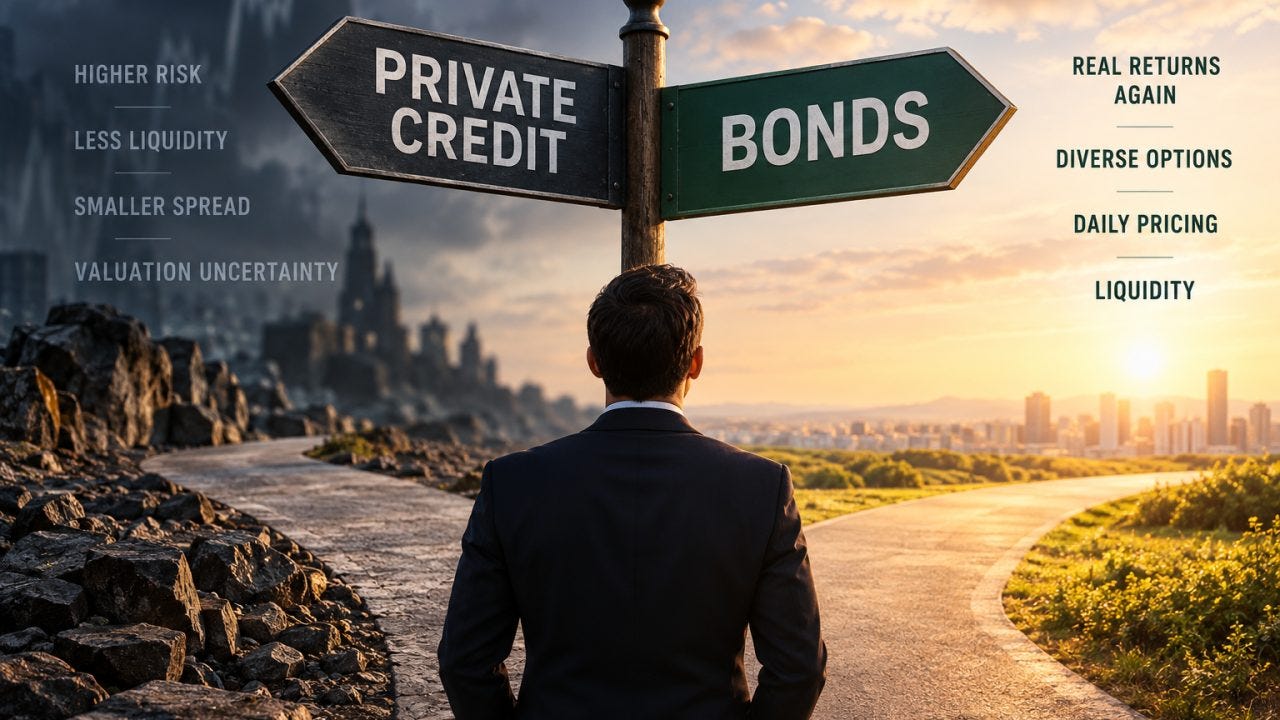
Retail private credit was created for a world where safe bonds offered no real return after inflation. That world is over. Treasuries now provide a real return again. Two elements that helped private credit appear preferable to bonds have also flipped. If clients purchased private credit based on the premise that bonds did not provide a return, it is now worth evaluating whether that continues to be true.
That is the thesis. The rest of this article will provide supporting evidence.
The World It Was Built For
I have been in the bonds market since 1990. For the first half of that time, Treasuries provided a return after inflation. Many retirees relied on Treasuries and munis for retirement income. For the most part, this was not viewed as playing it safe. These were simply bonds.
That started to change after the financial crisis. The Federal Reserve lowered rates to zero in December 2008 and maintained those rates for seven years. By 2012, the yield on the 10-year TIPS was negative. By 2021 the yield on the 10-year TIPS was approximately minus 1%. Investors were paying for inflation protection from the government.
Clients still needed income. A client with one million invested in Treasuries in 2021 would have received nearly nothing after inflation. There was real pressure on advisors to provide some income.
Retail private credit stepped in to meet this need. Non-traded BDCs increased during the 2010s. The story was clear and appropriate to the time. These funds distributed at a high level and had very stable NAVs. Blackstone launched the private credit fund BCRED in January 2021 at the same time that the yield on the 10-year TIPS was approximately minus 1%.
At that time, private credit made sense. Bonds were not providing any return. Private credit was.
The Year That Proved It
Then came 2022. In March the Federal Reserve began raising rates and they have continued through 2023 with rates crossing 5% in that year. The Bloomberg US Aggregate lost approximately 13% in 2022. This was the worst annual performance of that index in many decades. Clients with investments in "safe" bonds saw double-digit losses on their statements.
Private credit funds did not exhibit that behavior. The loans were floating. Each hike in rates increased the cash flows from the loans. A bond fund was losing on rising rates while a private credit fund's income increased with rising rates.
The NAVs were also largely stable. This was not because the loans were immune to 2022. Instead, the price of the loans was set once a quarter by an independent valuation firm and by the fund manager. Public bonds provided a daily bid and in 2022 that bid continued to decline.
Imagine a situation where an advisor is sitting across from a client who just experienced a double-digit loss in a bond fund. On one side of the table is a fund that lost money. On the other is a fund that increased in return and had a largely stable NAV. The situation is self-explanatory. There was significant money transacted on it.
There were two key aspects to this situation. First, floating rates were more than fixed rates. Second, the price was not based on trading. Neither of these two conditions still apply.
What Changed: Bonds Are Now Providing a Return
On September 17 a reopening of a 10-year TIPS cleared at a real yield of 2.653%. This was the highest clearing seen since October 2008. On September 30 the 10-year Treasury hit 5.34%. This was the highest 10-year Treasury since 2002.
This is not an inflation scare. At the time of the auction the breakeven on the 10-year was 2.3% which is approximately where it has been throughout the year. This is not inflation fear. Investors are simply being provided a real return for lending to the government over ten years.
The rest of the bond market followed this trend. On October 1 the investment grade corporate index was yielding 5.99%. High yield bonds were yielding approximately 8.4% at the end of September. The 30-year muni yield closed on September 29 at 5.26%. This is approximately 90% of the yield on the 30-year Treasury before taxes. This is a very attractive offer for a client in the highest tax bracket.
So now the question from 2021 can be updated. Clients do need income. Treasuries, TIPS, munis and corporates are now providing this income and offering daily pricing with no restriction on the exit from the investment.
The First Reason Has Flipped
SOFR was above 5% at the end of 2023. The yield on the 10-year was 3.88%. Before any discussion about the spread, a floating rate loan was at an advantage over a ten year bond.
On October 1 SOFR was 3.87% and the yield on the 10-year was 5.24%. Again the gap is roughly the same. Now the bond is at an advantage.
Loan spreads also came in over the same period. Unitranche loans that cleared at the end of 2023 had a spread of approximately 590 bps over SOFR. In the first quarter of this year the spread was approximately 500 bps. On today's SOFR, a new loan will provide a return of approximately 8.9%. High yield bonds were yielding 8.4% at the end of September. The added benefit of owning a private loan is down to approximately half a point before fund fees.
That half point also includes more risk than in the past. As of June 30 according to Morningstar DBRS 78% of rated issuers of private credit were rated B or below. The median private credit borrower is covering 1.72 times its interest. 14.1% of borrowers do not cover their interest. When floating rates increased the interest paid by the borrower also increased while the income of the lender increased. These borrowers are still carrying that higher interest.
The Second Reason Is Deteriorating
For many years the only price on private credit funds was the NAV provided by the fund. This is also changing.
First is the line at the door. Shareholders of BCRED requested the redemption of approximately 10% of the fund in the second quarter, representing approximately $4.5 billion. The maximum redemption is 5% per quarter. Blackstone redeemed approximately half of that amount, leaving approximately $2.3 billion in unsatisfied requests. In the third quarter requests were again approximately 10% of the fund at $4.3 billion. Approximately half of this amount appears to be shareholders requesting for a second time according to TD Cowen.
New money is still being subscribed. BCRED received approximately $750 million in new subscriptions in the third quarter. However, there was still approximately a 3% net outflow from NAV. Money can be coming in at any time. Money can be leaving on a schedule.
Second is the emergence of another price. On a third party basis an offer of $20.65 per share has been made for BCRED against a NAV of $23.60. This is 12.5% below NAV or $2.95 per share. A similar offer has been made for HLEND that is 17.5% below NAV.
That offer is more important than its size. This is the first time that many of the shareholders have witnessed a price provided by a party that is actually interested in purchasing. Also, this price is lower than the fund's NAV.
The money in the industry has also noted this. In the first quarter of this year non-traded BDCs raised $4.9 billion and redeemed $6.9 billion. According to Robert A. Stanger no previous quarter in the history of this product had more money exiting than entering.
Why It Is Still Being Sold
If the reason for owning a fund of private credit has weakened, why is it still being sold?
Part of the explanation lies in the slow pace at which sales materials are updated. The sales pitch that worked in 2021 and 2022 can still sound right if the numbers are not updated.
Part of the explanation lies in economics. There is no trail earned from a Treasury. TIPS are available for free through TreasuryDirect auctions. Muni buyers pay the dealer a markup once. The individual share classes for non-traded funds sold through brokers also carry an annual servicing fee for as long as the client remains invested.
Incentives do not make a fund bad. Instead they can be used to explain which funds get included in sales materials.
I've Seen This Before
There have been other products created for one rate environment and sold in a different rate environment.
In 1994 it was inverse floaters. These had floating coupons that increased when interest rates were going down. This made them appear desirable in a low rate environment. In 1994, Orange County loaded up on these with borrowed money. In February 1994 the Federal Reserve began increasing rates. By the end of the year Orange County lost approximately $1.6 billion and filed for bankruptcy. The securities did just what they were designed to do. The world they were created for ended.
In 2008 it was auction rate securities. These were long-term bonds that had rates reset every few weeks through auctions. Brokers also sold these to individuals for a safe place to store cash. The market was valued at approximately $330 billion. In February 2008 the auctions failed. Individuals who thought they were holding cash instead held long term bonds that no one would bid on. Most of these investors only exited through regulatory and settlement processes.
Neither of these products was fraudulent. Each was created for a specific environment. Each one was sold after that environment was over.
What This Is and Is Not
Private credit is not broken and most funds in this category are not in trouble. Many of the loans in these funds are in good health. Many clients own these funds for appropriate reasons and these reasons still exist.
The issue is more limited than this. Many clients owned these funds based on the premise that bonds did not provide income. This premise no longer exists. So it is worthwhile to pose four questions for each position in a client's book involving private credit.
Why did the client purchase this? If the answer was income when bonds did not provide income, that premise no longer exists.
What would the same income cost in public bonds today? At the time of this writing the 10-year was approximately 5.3% and TIPS was providing a real return after inflation at 2.65%. The answer to this question will be very different from the answer in 2021.
What is the exit cost? Look at the line at the door, the maximum redemption of 5% per quarter and any offer from a third party below NAV.
Is the added half point worth the borrower quality, fees and exit? For some clients this may be. For others it may not be.
The lesson is not that clients should exit these funds. Instead the reason for their purchase should still hold.
What do your clients own that was created for zero rates?
Get Behind the Yield free by email. Short enough to read before your first meeting, specific enough to use in it. Subscribe here.
Need CE hours? Six self-study bond courses, accepted by CFP Board. See the courses.