
Behind the Yield
Buy the Dates, Not the Forecast
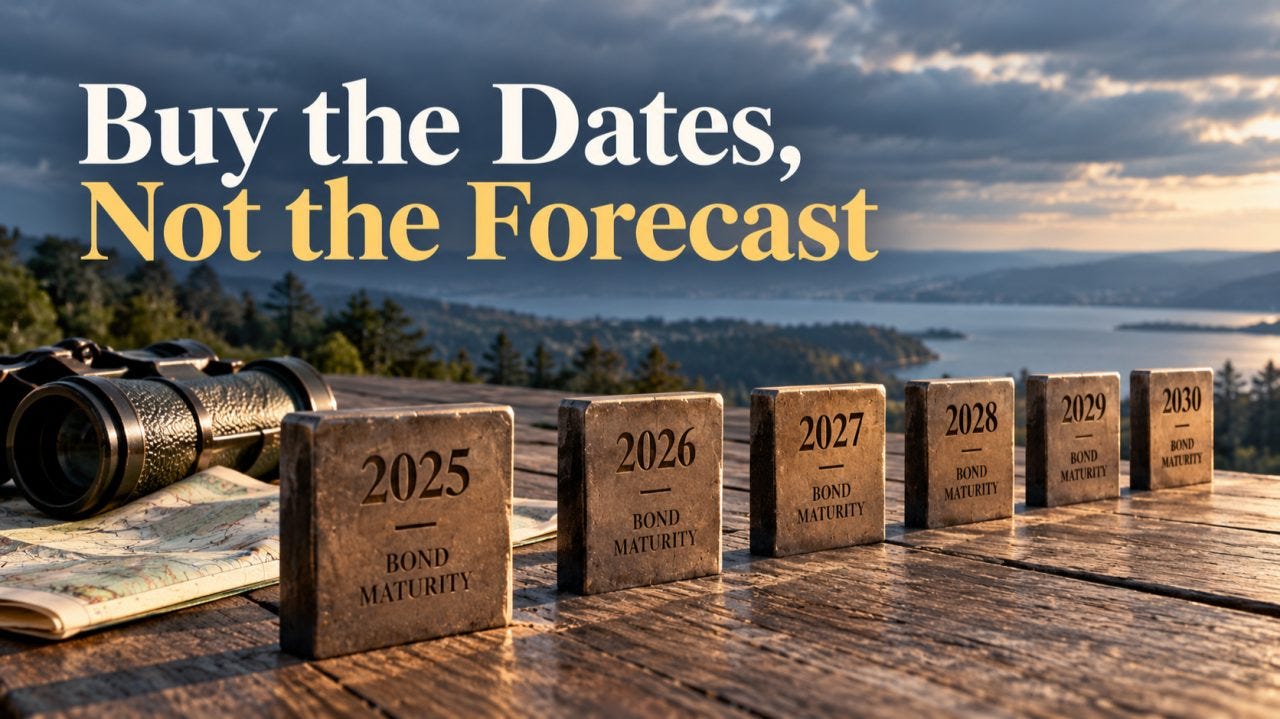
The 30-year Treasury traded at 5.44% last week. That is its highest level since 2004. The advisors who emerge from the storm unharmed will be those who have moved away from trying to call the peak in yields and have started buying bonds for the dates they mature. It worked in 1994. It works now.
On September 16 the FOMC raised the fed funds target a quarter point to a range of 3.75% to 4.00%. This was the first increase since July 2023, and there were no dissenters. Chair Kevin Warsh stuck to the facts: "The plain fact is that inflation is too high and has been for too long." He also said he would be "hard-pressed to describe broad financial conditions as restrictive," i.e., we may not be done yet. The dot plot reflected the same message: 16 of 18 committee members expect at least one more increase this year.
The long end had already anticipated the move. The 10-year Treasury closed on September 16 at 5.01%. It had risen 83 basis points from the start of the year.
At the beginning of the year the consensus had one or two rate cuts in 2026 for the Fed and the 10-year around 4%. Thus we are off by about a point from the consensus on the most watched rate in the world in less than nine months. I don't say this to criticize the strategists. Rather, I say this because any strategy that requires knowing what happens to rates in the future has received a grade.
We have seen this before
I was a new hire on a bond team at Lehman Brothers in February 1994 when the Fed caught us flat-footed. The funds rate had been raised from 3% to 3.25%, and then it continued to rise. By February 1995 the rate was 6%. The 10-year rate rose from about 5.2% in the fall of 1993 to almost 8% one year later. Orange County in California had taken on a large amount of debt to bet on rates staying low and then filed for bankruptcy in December 1994 having lost about $1.6 billion.
The takeaway for most after 1994 was that bonds can lose money. For me, it was the takeaway about who did not suffer. Those who held bonds to a known maturity date and who were using the coupon income did well. Their statements looked bad for a year, but their income never did decrease and every bond that matured was reinvested at a higher rate. Those who suffered tended to have either borrowed to hold duration or had to sell prior to the return of the market.
For most advisory clients today, leverage is not an issue. Forced selling is. And forced selling typically starts with a client who was never told the purpose of the bonds.
What is different this time
The Fed is raising rates on a curve that is already upward sloping. On September 24 the 2-year yield was around 4.9% and the 10-year was over 5%. The slope of this curve matters because an investor is compensated for extending the maturity. For much of 2022 and 2023 the curve was inverted which meant that extending the maturity was at a cost to the investor.
The causes behind the sell-off are also more complicated than just a single inflation reading. Vanguard points to persistent deficits and the competition from an AI-driven investment cycle for capital. The hyperscalers alone have sold approximately $150 billion of investment grade bonds this year, or over 8% of all investment grade issuance this year according to Empower. This is a significant amount of new issuance on top of Treasury supply.
Natixis' US rates strategist John Briggs said in mid-September that the sentiment was bad. He was referring to the lack of demand even though real yields are attractive. Bad sentiment and fair value can exist in the same market for a long time. This was true in 1994.
The statement problem
Clients are about to receive their third-quarter statements. The core bond position will not look good. Through August 31 the Bloomberg US Aggregate was down 0.31% for the year. The five-year annualized return was negative 0.29%. These numbers pre-date the sell-off in September.
This is the second dip in four years. The Agg fell about 13% in 2022. A client who was told back then that bonds were "back" has a fair question to ask now.
The answer depends on the position held. A core bond fund does not have a maturity date and thus does not return par. After rates rise, the fund recovers by reinvesting at the new higher rates. A reasonable estimate is that the recovery takes about the same amount of time as the duration of the fund. The Agg has a duration of nearly six years. Thus, it "will come back" actually means it should come back over about six years assuming rates stabilize. Some clients are okay with this. Others would prefer to have heard this prior to their receipt of the statement.
Buy bonds for the dates
A ladder of bonds will also suffer. I think most advisors do themselves a disservice by pretending that this does not occur. With a ladder of bonds each bond has a maturity date and a par value. The client can see both these things. A statement will show a price. The client knows what they will receive and when.
When one of the bonds in the ladder matures the proceeds go to the end of the ladder at whatever yield the market is paying that day. That yield is much higher than it was in January. Rates rising make the prices of the bonds that are already in place lower and make the rate on bonds bought at a later time higher. For a client who is holding and spending the coupon, the higher rate on all newly purchased bonds wins out over time.
The implementation for this strategy is straightforward. Determine the dates on which the client will require cash and buy bonds that mature on or before those dates. Before anything else, ask: will any of this have to be sold prior to the maturity date? If the answer is yes then this cash may more appropriately be placed in a shorter or more liquid position. The client should understand why.
Don't hide in bills
Treasury bills after the rate hike are currently paying around 4%. This rate may appear safe for now and it is. The risk will emerge later.
Recall the clients who had everything in cash in 2023. They made good money for a couple of years. Then the Fed cut three times in 2025 and their income decreased with each cut. The same Fed that caught clients off guard as rates rose can also catch them off guard as rates decrease. A client with no assets locked in receives no warning. A ladder allows the client to share some of the front-end income while still holding long dated bonds at today's rates. There is no need to pick a side in the rate game.
Buy the inflation protection
The Fed is raising rates for inflation. It makes sense to directly hold the asset designed to protect against inflation. On September 9 the 5-year real yield on the Treasury was 2.20%. The long-term average real yield is 0.58%. A real yield over 2% implies that TIPS will provide that amount more than the amount of actual inflation that occurs.
A ladder of short TIPS matched to the next five to ten years of spending is directly aligned to the very thing that is causing the Fed to raise rates. A warning should be applied here. The inflation adjustment in TIPS is taxed annually even though it is not received until maturity (the so-called phantom income). This means TIPS are typically held in an IRA and not in a taxable account.
For taxable clients look at the long end of the muni curve
The long end of the muni curve should be looked at by clients in high tax brackets. At the beginning of September Municipal Market Data had the 30-year muni-to-Treasury ratio at 93%. At that ratio and with the 30-year Treasury near 5.35% a top-rated muni could yield nearly 5.0% before tax benefits. For a client paying the top federal rate as well as the 3.8% investment income tax the taxable equivalent yield would be around 8.4%.
Two considerations before purchasing. Most long munis have a call after 10 years. Price accordingly to both the call and to maturity. Ratios also change. The 10-year ratio was closer to 75% at the same time. Thus the value is concentrated on the longer end.
Keep an eye on the floating rate offering
You will hear that floating rate products are the way to deal with rising rates. Private credit and bank loan funds will promote this. The coupon does reset higher. Thus there is some truth to the promotion.
Who pays that higher coupon? A floating rate loan protects the lender from rising rates by transferring the rate risk to the borrower. A mid-sized company with a newly increased interest rate is a weaker credit than it was in July. The client still bears the rate risk. The rate risk has become a credit risk. A quarterly statement will not capture this.
Client conversation
Clients do not need a rate forecast from their advisor. The market just showed how little a rate forecast is worth. Clients need to understand the purpose of each piece in their bond position and also need to understand what will occur to each piece as rates continue to rise.
For money needed at a specific point in time buy bonds that mature by that point in time. Let higher rates work for the client each time a bond matures and is reinvested. For money in a fund provide the honest recovery math. For inflation purchase the protection directly at a real yield we have not seen in years. For taxable clients in high tax brackets look at the long end of the muni curve. And when a product claims to eliminate rate risk, understand where that risk has gone.
The Fed may raise rates again at its next meeting or at the one after that. Or it may not. A portfolio built around dates and cash flows does not need to know which.
Get Behind the Yield free by email. Short enough to read before your first meeting, specific enough to use in it. Subscribe here.
Need CE hours? Six self-study bond courses, accepted by CFP Board. See the courses.