
Behind the Yield
Same Loans, Two Prices
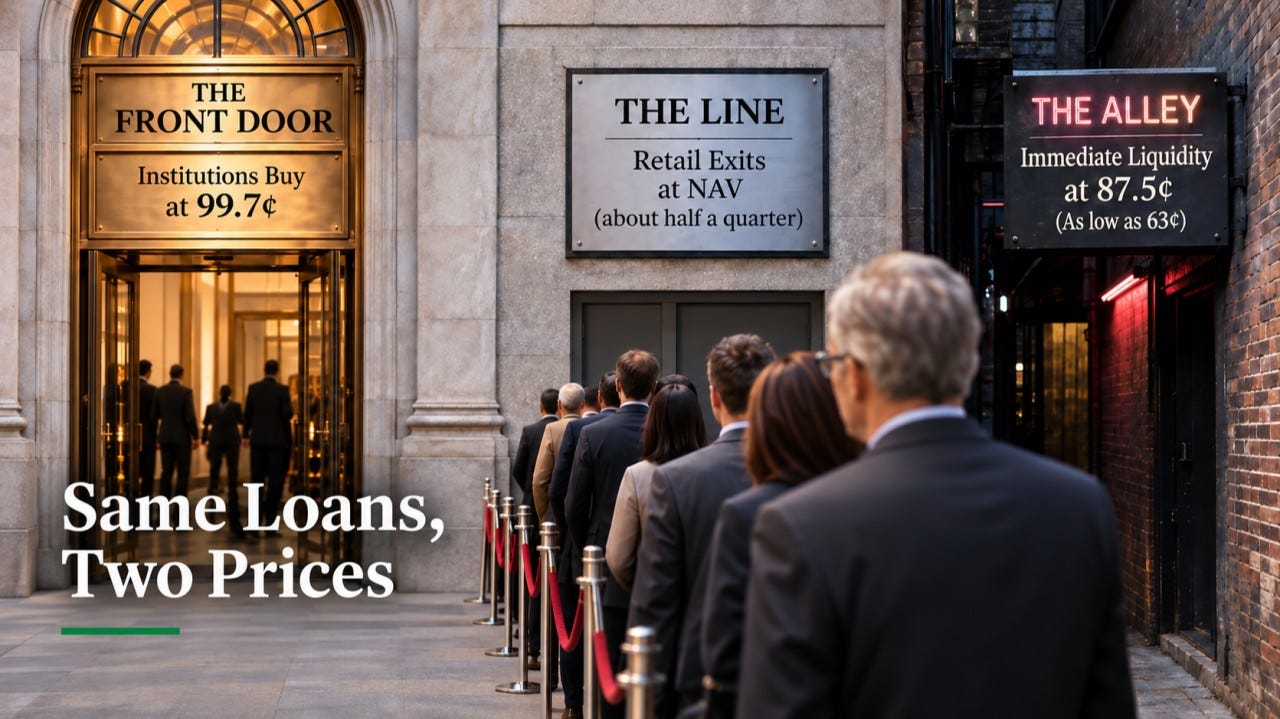
This year, a pension fund bought private loans from Blue Owl for 99.7 cents on the dollar. Today, someone who wants to exit a Blackstone private credit fund can receive a cash bid of 87.5 cents, and some are getting bids in the 60s.
Same kind of loans.
Same kind of managers.
Different seller.
That is private credit in 2026: Institutions are buying while retail is exiting, at a cost depending on which side of the equation you're on.
THE LINE
Hardly anyone is raising money anymore. According to Stanger, publicly registered non-listed BDCs raised $1.5 billion in the third quarter. That's down 87% from the previous year. This is the weakest quarter since late 2020.
That said, people are still exiting. For the third quarter in a row, redemptions have outpaced fundraising, leading to a net outflow of $4.1 billion.
I watch BCRED as it is the largest of these funds. In Q3 alone, investors requested to sell 181.3 million shares. Blackstone repurchased 90.4 million. The fill rate was 49.9% in Q3, compared to 48.5% in Q2.
Other funds aren't much different. Ares's ASIF saw requests drop from 14.4% of shares to 13.1%. Apollo's ADS dropped from 16.8% to 14.7%. Blue Owl Credit Income received $3.1 billion in requests, or 16.8% of its shares. Blue Owl said it expected to accept about 30% of the shares tendered.
So yes, the line is a bit shorter. According to one executive interviewed by InvestmentNews, demand may be "cresting." A wave crests just before it hits someone.
And the line isn't as new as it looks. According to TD Cowen, roughly half of the requests made in BCRED in Q3 were carried over from Q2.
THE ALLEY
If you don't want to wait, someone will buy you out. At a price.
That someone is Cox Capital. They literally named their fund Cox Capital Retail Secondaries Fund I. At least they're not hiding the ball.
In September, Cox offered to buy BCRED shares for $20.65. At the time, Blackstone valued those shares at $23.60. That's 12.5% under NAV.
Cox offered to buy HLEND shares for $20.17 while HPS valued them at $24.45. That's 17.5% under.
For shares of Apollo's fund, Cox offered $20.35 compared to a NAV of $23.84. For Ares, Cox offered $23.15 compared to $26.74. Both offers were valid until 5 p.m. on November 14.
These are the nice offers. Earlier this summer, Cox bid about 30% below NAV for Apollo's fund. It bid 37.1% below NAV for Blue Owl Technology Income. Earlier this spring, Saba and Cox offered to buy OBDC II shares for $3.80, while the board stated the shares were worth $5.69 and told people to say no.
Put it in client dollars. For a $100,000 position in BCRED, Cox would give you $87,500. The missing $12,500 is the cost of opting not to wait.
I don't think Cox is the villain. People don't have to sell. Liquidity has never been free (just ask anyone who sold munis in March 2020). According to Blue Vault, a low outside bid doesn't necessarily mean the NAV is incorrect. Cox claims they are basing their price on publicly traded BDCs, and those were also cheap. According to Barron's in February, Blue Owl's two listed BDCs were trading around 22% and 32% below NAV.
Alright, fair enough. Save the 12.5% for later.
THE FRONT DOOR
On February 18, Blue Owl needed cash and sold $1.4 billion in loans from three of its BDCs.
Four institutional investors bought these loans. According to Bloomberg, three were big pensions: CalPERS, OMERS, and BCI. The fourth was Kuvare, an insurer that Blue Owl manages money for.
The loans were made to 128 companies across 27 industries, mostly internet software.
They were sold for 99.7% of par.
This is not a fire sale. My car can lose more when driving out of the dealership.
A few weeks later, Saba and Cox were offering roughly two-thirds of NAV for retail shares in OBDC II.
I know this isn't a fair comparison because a fund share has leverage, fees, and a waiting line. A loan does not. And a pension that spent months searching through $1.4 billion in loans did not purchase the whole book. According to the Wall Street Journal's Jonathan Weil, some of these investors, particularly CalPERS, already had pieces of the same loans and thus had a reason not to want them marked down (Weil also noted that Kuvare is not technically considered a related party).
Nevertheless, institutional investors bought the loans at the mark while retail investors were offered a price well below it. The mark held up well when the institutions were buying.
THE PEOPLE COMING IN
In the third quarter, Blackstone raised $63.3 billion. Of this, $35.8 billion came from credit and insurance. That included $16.5 billion from insurance separate accounts. Despite relatively muted BCRED flows, Blackstone said institutional investors continued to come in.
In the same quarter, BCRED lost $1.4 billion net. Once again, NAV per share decreased, and this has happened for five consecutive quarters.
So, one company was able to both pour money into the front door and let it leak out through the back.
A Nuveen executive told ai-CIO that retail selling at a discount while the credit holds up "may actually be a buying opportunity." I respect that. He just said it out loud.
Earlier this spring, according to Bloomberg Intelligence, 57% of the institutional LPs it surveyed had a negative or very negative view of retail investors entering private markets at all.
They did not want you at the party, but they are willing to buy your coat as you leave.
THE BOARD
When Cox attempted to buy BCRED shares, the board filed an 8-K form stating that investors should reject this offer because it "substantially undervalues" the shares.
I believe the board. They think the shares are worth $23.60.
The fund will pay $23.60 too. To roughly half of those who request to sell.
I think the board has a solid reason, and I'll give them that. With the 5% cap, the people who remain in the fund are protected. If everyone were paid what the shares were worth, the fund would need to sell loans to generate the funds. It would sell the good loans first, because those are the ones that sell, and those who remained would ultimately be left holding the rest. According to the fund's prospectus, this cap has always been in place.
The cap also sets how much people pay to exit early, and it lets Cox be the one who sets it.
WHAT I'D DO
First: Do the math for waiting. According to BCRED, those who requested to sell in both Q2 and Q3 received roughly 75% of their requested amount within about 90 days. As of August, the fund was paying a 9.1% distribution rate, and that continues while your client waits. Giving up 12.5% on the whole position to skip the wait on the last quarter of it is an expensive cab ride.
Second: Find out who's on the other side. The pension that paid 99.7 has its own book to protect, and the secondaries fund paying 87.5 has a return goal, so someone will always get the difference. Be sure that it is not coming out of your client by accident.
Third: Monitor the outside bids. They are the only real market price these shares have. Cox's discount on Apollo's fund dropped from roughly 30% in July to 14.6% in September. Some of this is because the NAV dropped toward the offer. Cox says every fund it bid on reported a lower June 30 NAV after its offer was announced. Once the NAV and the offer are close together, determine which one has changed.
Fourth: Price the exit when you sell the product. The yield on the statement assumes that your client will never need to exit. If they potentially do, this cost should be included in the math. Currently, there is an actual number for this cost.
LAST CALL
For over 30 years, I have worked in bonds, and liquidity has always functioned like this: It is never charged until you need it, and then you are charged full retail.
Right now, the front door opens at 99.7. On a good day, the alley opens at 87.5; on a bad day, it opens at around 63. The line pays NAV, roughly half at a time.
So here is a genuine question for the sponsors: If the loans are worth 99.7 to a pension fund, why is the best offer for a retail share 12.5% lower, and who should pay that difference?
Get Behind the Yield free by email. Short enough to read before your first meeting, specific enough to use in it. Subscribe here.
Need CE hours? Six self-study bond courses, accepted by CFP Board. See the courses.