
Behind the Yield
The Emerson Files, Part 2 of 4
Part 2 of 4
The Machine
Two products. Two bankruptcies. $100 million in commissions. And the retirement seminars that sold them.
By Charles Urquhart, CFA
A quick reminder of how we got here. Earlier this year, I noticed that a $15 billion BlackRock fund called HLEND raised 43% of its capital through an entity the prospectus would not name. It called them the "Founding Distributor." Every other major non-traded BDC names its distribution partners. This one did not. So I followed the filings. They led me to Emerson Equity LLC of San Mateo, California.
In Part 2 of this series, I will tell you how Emerson Equity made its money. Not through its consulting firm or its management of alternative investments for its clients. No, the firm made its money through the distribution of two products that both ended in bankruptcy - and the commissions generated by those products.
The first product that Emerson Equity distributed was called the L Bond.
GWG Holdings, of Dallas, Texas, purchased life insurance policies from the secondary market. A retiree could sell their life insurance policy to GWG for a fraction of the value of the policy. Should the retiree pass on or become disabled, GWG would receive the $1 million insurance policy benefit. However, because they had to purchase life insurance policies from the secondary market to fulfill this undertaking, GWG issued its own bonds. These were called L Bonds.
The bonds were unrated by any credit rating agency. They were not tradable on any secondary market. Should an individual purchase an L Bond from GWG, they could not sell the bond. The company could purchase the bond back from an investor at any time for a 6% fee, but L Bonds offered yields between 5.5% and 8.5% over a maturity period of two to seven years.
In 2020, Emerson Equity became the managing broker-dealer for GWG's L Bonds. The company pledged to distribute L Bonds to investors through over 140 regional brokerage firms. These broker-dealers were able to earn a percentage of the L Bonds sold to investors: up to 8% of the amount invested by an individual investor.
In August 2025, the Securities and Exchange Commission (SEC) published an administrative order describing the misdeeds of an individual named Tony Barouti, a registered representative for Emerson Equity:
The order stated that ten retail customers of Barouti's office were provided with L Bond recommendations. During the suitability questionnaire that Barouti completed on behalf of these retail customers, he checked all boxes on the form that indicated that each of the customers had "extensive" investing experience in financial products as varied as venture capital and commodities. However, the SEC found that at least four of these customers did not have any experience investing in financial products.
Some of these customers included an individual that was 70 years of age and had invested $180,000 in a seven-year maturity L Bond. This represented 72% of the customer's net worth, on $50,000 of annual income. Another customer was an 85-year-old who invested $200,000 in the L Bond, or 40% of her net worth. Another customer was a 48-year-old who invested $50,000 in the bond, or half of all of his assets.
The SEC found that Emerson Equity had willfully violated Regulation Best Interest. The term willfully in this case specifically indicates that the firm was aware of its wrongdoing.
Tony Barouti ran infomercials on Persian radio stations to reach the elderly Iranian-American community. His BrokerCheck report lists 57 prior customer disputes and 11 pending.
On January 15, 2022, GWG defaulted on the L Bonds it had issued to individual investors. On April 20, 2022, the company filed for Chapter 11 bankruptcy proceedings to manage its debt. In November 2024, Brad Heppner, the company's former chairman and founder of another company that manufactures life insurance policies, Beneficient, was arrested on federal charges of fraud in connection with the bankruptcy of GWG.
Twenty-six thousand investors who purchased L Bonds from GWG were to receive between 2.7% and 3.45% of their original investment from the company's Wind Down Trust following the bankruptcy of GWG. In monetary value, that meant that these investors were to receive between $27 and $35 for every $1,000 that they had invested in the company and its L Bonds.
The SEC fined Emerson Equity $105,041. Tony Barouti paid $112,000.
The managing broker-dealer for a $2 billion offering of L Bonds earned a fine that was equivalent to the commission that they collected for the sale of a single L Bond.
While the L Bonds were causing concern for the investors and the firm was paying fines for its wrongdoing, the firm had another product to sell.
Inspired Healthcare Capital, or IHC, was established in 2016 by Luke Lee in Scottsdale, Arizona. During this time, the firm purchased and managed healthcare facilities for 14 different states. In 2020, they began offering Delaware Statutory Trust offerings for capital investments in their healthcare facilities.
Emerson Equity became the managing broker-dealer for 29 of IHC's Delaware Statutory Trust offerings and all of its investment funds. According to the firm's bankruptcy filing, Emerson Equity managed this many offerings through the company's IHC investments.
According to attorneys that represented investors in IHC's Delaware Statutory Trust offerings, their compensation structure for selling these offerings was as follows: 6% sales commission, 1% dealer management fee, 1% broker-dealer allowance, 1.5% wholesaling fee, and 3% marketing fee. That totals to 12.5% of the investor's capital required to purchase a Delaware Statutory Trust offering.
Thus, an individual investor that put $1 million into an IHC Delaware Statutory Trust was required to contribute $125,000 into the offering for the company's distribution and sales agents.
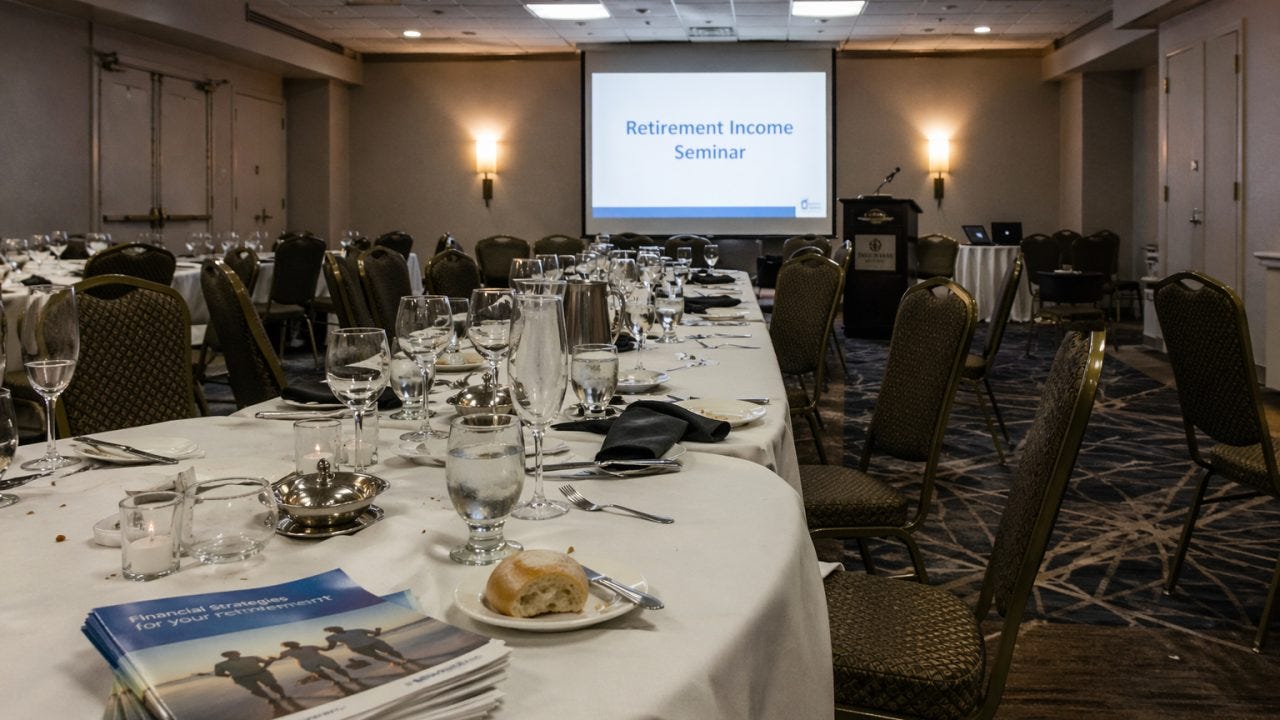
Emerson's registered representatives for IHC sold their Delaware Statutory Trust offerings under the entity "The Sherer Group." These individuals placed flyers in direct mail packages in the homes of elderly individuals. The flyers advertised their upcoming free retirement planning seminars.
At these retirement planning seminars, the registered representatives of Emerson Equity introduced the concept of the 1031 exchange and Delaware Statutory Trust offerings by Inspired Healthcare Capital. Individuals who owned rental properties could sell those properties, defer any capital gains that would emerge from the sale, and use those funds to purchase a Delaware Statutory Trust that would provide them with a monthly income from the properties owned by Inspired Healthcare Capital.
According to one case description published by an attorney that represents the investors of The Sherer Group, two individuals in their seventies who had learned of Emerson and Inspired Healthcare Capital through these direct mailers and seminars placed $3 million into Inspired Healthcare Capital. Their efforts to gain the trust of the investors was evident when the individuals were flown to the company's headquarters, paid for their travel and lodging expenses, and "wooed" into investing in the Delaware Statutory Trust by the company leadership. Furthermore, sixty-two percent of their investment portfolio was placed into Inspired Healthcare Capital. These two investors made clear to the registered representatives and company that they did not wish to take any undue risks on their investments.
According to another case description of an investor in California, the investor was recruited by The Sherer Group through direct mail and seminars. The customer in this case had invested more than $1 million in Inspired Healthcare Capital through its Delaware Statutory Trust offerings. The investor was not informed of the fees of up to $125,000 earned by The Sherer Group from his investment. He has since suffered a near-total loss of his investment in Inspired Healthcare Capital.
Furthermore, according to one case description, one registered representative of Emerson Equity simultaneously held the title of President of Capital Markets for Inspired Healthcare Capital and was a registered representative for Emerson Equity. Thus, he was simultaneously selling securities for his company and his firm.
On July 17, 2025, Inspired Healthcare Capital suspended all new investments into its Delaware Statutory Trust offerings. On February 2, 2026, Inspired Healthcare Capital filed a petition for Chapter 11 bankruptcy. In its petition, the company described its liabilities to range between $1 billion and $10 billion. According to the firm's chief restructuring officer, Inspired Healthcare Capital has sold over $1.2 billion in Delaware Statutory Trust offerings and managed funds from approximately 4,800 investors since 2016. Furthermore, these funds have been used by the firm's former management team to purchase luxury cars, a vacation condo in Las Vegas, and to cover their personal expenses, including the purchase of real estate within a company that is owned by the firm's CEO and his wife.
According to publications by InvestmentNews, the firm's broker-dealers have earned over $100 million in commissions from Inspired Healthcare Capital. Furthermore, the percentage of the initial investments in Inspired Healthcare Capital that were taken by broker-dealers and their affiliates is 8.3%. This percentage is within the highest range of percentages defined as normal for the industry.
According to one senior executive for the firm's broker-dealer industry to Inspired Healthcare Capital, as published by InvestmentNews, "The broker-dealers who got the $100 million in commissions are going to face claw backs. By the time Inspired Healthcare gets liquidated and the trustees and lawyers get paid, there is not going to be much, if anything, left for investors."
A Texas bankruptcy judge has ordered Emerson Equity to produce any insurance policies, board meeting minutes, emails, and other communications related to the company's sales of Inspired Healthcare Capital securities. According to this court filing, Emerson Equity was "substantively involved" in Inspired Healthcare Capital's operations and fundraising.
Furthermore, Emerson Equity's affiliated entity, Emerson Equity Bridge Fund I, has sued Inspired Healthcare Capital's CEO. According to published case descriptions, the $1.5 million loan that the CEO received from the bridge fund was obtained through misrepresentations regarding his financial strength and the personal loans that he had taken on himself that total over $200 million.
Two products. The L Bonds were distributed through Persian-language radio infomercials targeting the elderly Iranian-American community. The Inspired Healthcare Capital Delaware Statutory Trust offerings were distributed through direct mailers and retirement planning seminars targeting elderly homeowners. Both products were sold by the same firm, earned outsized commissions from each sale, and both ended in bankruptcy. Furthermore, the total amount of money invested by individuals in these companies reached over $3 billion. The total amount of money that broker-dealers earned in commissions from the sales of Inspired Healthcare Capital securities alone reached over $100 million.
Though these companies sold different products, though they had different investment objectives and target customers, they followed the same sales strategy and model.
Find elderly individuals with savings in their portfolios. Offer them free seminars or reach them through radio infomercials. Gain their trust. Encourage them to place all of their savings into one company's offering. Collect the commission. Move on to the next product.
The firm made $96 million in revenue in 2025. Its largest revenue source was alternative investments. Half of the alternative investments revenue came from three customers.
In Part 3 of this series on the Emerson Files, I will introduce you to the registered representatives that sold both of these companies' products. Each of them will have a name, a BrokerCheck report, and a story of how they found themselves at Emerson Equity - many of them having come from the very companies that they sold the products of.
Next: The Emerson Files, Part 3: "The Reps"
The individuals who sold these products. The elderly retirees who bought them. The cultural affinity marketing. The complaint pattern. And the firm that kept hiring.
Charles Urquhart, CFA, is the founder of Fixed Income Resources and an adjunct professor of Fixed Income Securities at Loyola University Maryland's Sellinger School of Business. Mr. Urquhart spent 30 years in the financial industry working for firms such as Kidder Peabody, Lehman Brothers, Fidelity Capital Markets, Tradeweb, and Andrew Davidson & Co. Mr. Urquhart does not have a position in HLEND, no business relationships with Emerson Equity, HPS, and BlackRock, and has no financial interest in any of the litigation pending before the SEC and FINRA.
All of the pending legal issues referenced in this article are unproven allegations. The settlements referenced in this article are not admissions of wrongdoing. All information published in this article comes from the company's filings with the SEC, FINRA, BrokerCheck, financial and audit reports, bankruptcy court filings, publications by InvestmentNews, and case descriptions from the attorneys involved in the pending litigation with the companies referenced above.
Get Behind the Yield free by email. Short enough to read before your first meeting, specific enough to use in it. Subscribe here.
Need CE hours? Six self-study bond courses, accepted by CFP Board. See the courses.