
Behind the Yield
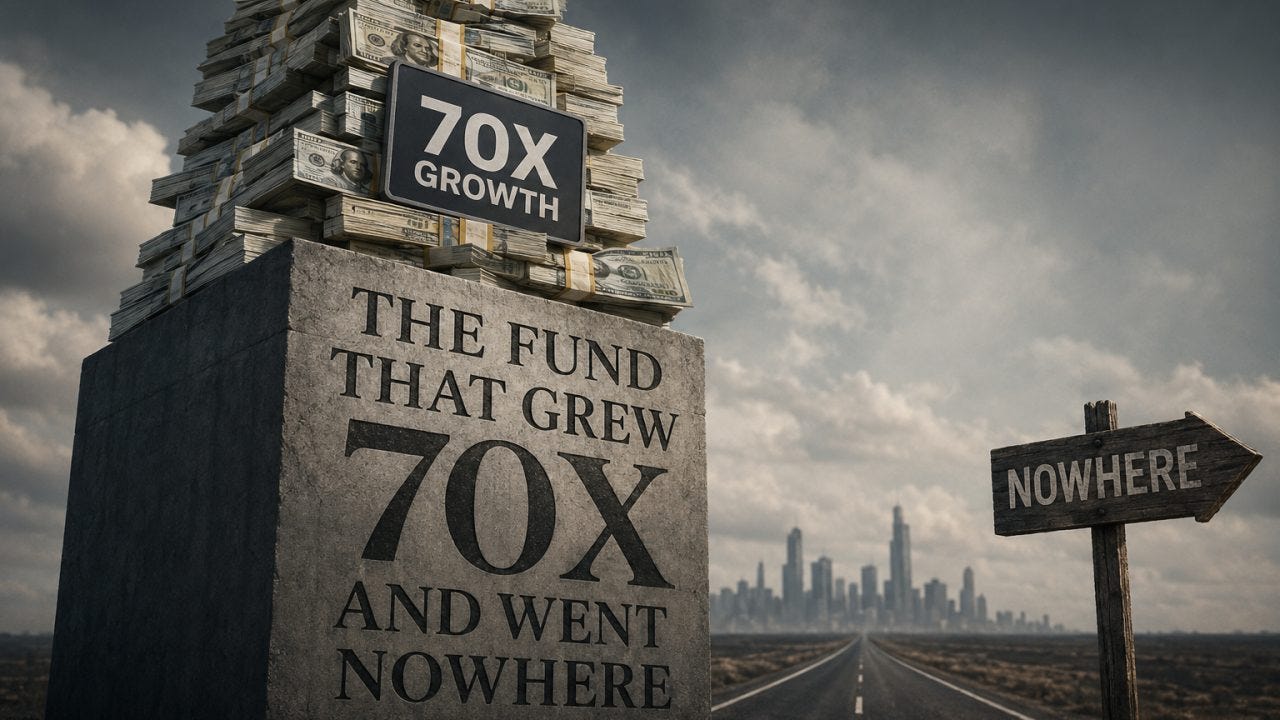
The Fund That Grew Seventy Times and Went Nowhere
Somewhere in America there is a financial advisor who feels very good about a decision he made three years ago.
About three years ago, in late 2022, the advisor invested some of his clients' money into a private credit fund from Ares. The decision sounded great to the advisor. The fund would invest in loans and would be managed by someone who had decades of experience in the industry and who had few losses that would require a microscope to find them. The advisor's clients wanted high yields on their deposits, so this investment would provide that for them. Thus, the advisor made the investment and moved on.
He has been getting his distributions from the fund ever since. He gets nine and a half percent per year, on time every time. People are happy, and he is content with the decision that he made.
He has never once asked the only question that matters.
The question that he should be asking is: where is the money coming from?
He knows where the distributions are coming from. He has thought about the fund's operations a thousand times. The fund lends money to companies and they pay interest to the fund. The fund distributes that interest to its clients. It is as simple as that.
WHAT THE FILINGS ACTUALLY SAY
But that is not what is happening. And yet, you do not need a subpoena to prove it. You do not need to rely upon a leak from the fund, or a whistleblower, or a friend on the inside of the fund to reveal its secrets. You only need to consult the fund's audited financial statements. They are publicly available documents filed with the SEC. Anyone can find them in about ninety seconds. Almost nobody reads them. Least of all the people selling the thing.
Here is what they say.
In 2025, the fund earned $735 million in net investment income. That is the money that the fund's portfolio earned during that year. The real thing. The interest that the borrowers paid to the fund, minus the costs of operating the fund. That is the number that is supposed to fund your client's retirement income.
In that same year, the fund paid out $816 million to its investors.
Look at those two numbers. The fund paid out to its investors eighty million dollars more than it earned.
That's ninety percent coverage. For every dollar that the fund distributed to its investors, it only earned ninety cents. Where did the remaining ten cents come from?
Ninety cents on the dollar is not considered a catastrophe in the world of investments. It is normal for a fund's coverage to dip below one hundred percent for a quarter or two, then recover. However, a downturn for an entire audited year is not normal. This alerts the investor to a question the advisor never asked: if the portfolio did not earn enough money to cover the distribution payments to the investors, what did?
The answer to this question is the most private-credit answer imaginable. Once you see it, you'll never unsee it, and it will change the way you read every one of these funds for the rest of your career.
New investors.
This fund attracted $5.5 billion from other financial advisors in 2025 who were seeking higher yields for their clients. That money came in through the front door of the fund, and some of it walked out the side door to the investors who got there first.
THE ONE TRUE SENTENCE
To be scrupulously fair to the fund, as Ares would be and within their rights, the fund will tell you that 100% of its distributions were funded from cash flow from operations. On the specific accounting definition of those terms, within the four corners of the cash flow statement, this is true. Hold onto that sentence. It is a small masterpiece.
The income statement, one page away from the cash flow statement, reveals another truth: that the net investment income did not cover the distribution. Both of these statements are true. They are true simultaneously because the cash flow from operations for a fund such as this is a tent large enough to march a circus through, with room to spare when eleven billion dollars a year comes through the door.
This should make you angry. This is the part the industry has gotten most comfortable relying on. They are not lying to you. What they have done is found the one sentence that avoids having to state the other. The other being that the fund did not earn what it paid the investors, and the difference was made up by the next guy in line.
The fund earns less than it pays out. The gap is filled by a rising ocean of new money.
This works beautifully. At least until it does not. The entire industry depends upon this ocean of new money rising forever and ever.
THE MOMENT IT STOPS RISING
Let me tell you about the moment it stops rising.
This fund does not trade on an exchange. You cannot sell your shares to some stranger who found you on some trading app out there in the wild because you are nervous about where your money is going. The only way out of this fund is by asking the fund to buy you out of it. And they only ever agree to a thin slice of the fund. Five percent of the fund per quarter is the exit. That is your door out of the fund. And it is not a wide door.
For years, nobody needed the door.
The fund was rolling in money. The five percent cap was theoretical.
Then people started walking toward the door.
In the first quarter of 2026, investors asked for 11.6% of the fund to be redeemed. More than double what the fund would honor. The fund, in accordance with its prospectus, paid out its five percent and asked the rest to get back in line.
You might think a locked door would settle investors who wanted out. It does the opposite. In the second quarter, redemption requests climbed to 14.4%. Again, capped at five percent. Again, most investors who came to the fund's locked door turned away at the glass.
Here is the mechanism nobody in the sales channel wants to explain, so I will. When the exit is crowded, you start pushing on the door. You ask for more than you actually want, knowing you'll only get a fraction of the request. Everybody does it at once. The fund is forced to sell assets to raise the cash, at the worst possible time, and the market marks the assets down as it goes, which sends the remaining holders to the door too. This is the machine in reverse, and it has already started.
And here is what those redemption numbers actually are. They are not panic. Panic is dumb money. This is smart money. A little over fourteen percent of the fund did the ninety-cent arithmetic and decided it was better to be early and slightly embarrassed than right and completely stuck.
IT IS NOT ONE FUND
If this were one fund alone, it would be one thing. It is not.
Go look at the flagship fund of Blackstone, BXSL, the bluest of the blue chips. For the second quarter of 2026, BXSL earned seventy-five cents a share against a dividend payment of seventy-seven cents, a ninety-seven percent coverage rate. Now, admittedly, one quarter's worth of returns might be noise in the grand scheme of things. But two quarters ago the fund had a coverage rate of 104%. Then 100%. Now 97%. Non-accrual loans are increasing. The value of the fund's portfolio is marked down. Yet the dividend is flat, unyielding, despite the softening earnings.
Blackstone will point to its cushion, so I will name it first. BXSL sits on about $1.80 a share of undistributed earnings, around $410 million, to burn through to fill the gap in its dividend. Fine. That will last a few quarters. It does not fix the trajectory. Spending your savings to pay for a dividend you no longer earn is not an act of financial strength. It is the problem dressed up as the solution.
Go look at Blue Owl's OBDC. Investment income dropped seventeen percent in a year, from $486 million to $401 million. Still, the company covered its dividend by trimming expenses and buying back stock. This solution will last a while. Unfortunately, it is not a plan to address the underlying problem.
Three funds. Three of the biggest names in the business. All with the same signature in common.
THE TELL
There is one more piece to the puzzle, the piece that makes it hard for people outside the fund to see the entire picture. This is presumably the point.
When the Ares fund began, it borrowed seventy-three cents for every dollar of equity. Now it borrows more than two dollars for every dollar of equity. The leverage nearly tripled. Yet despite the fund's extraordinary growth over the past three years, the value of each share barely changed. Twenty-five seventy at the start. Twenty-seven forty-eight now. That is it. After three years and growing into one of the largest funds of its kind, Ares is borrowing more money than ever before, and each share of the fund is still worth about what it was when the fund started.
Sit with that for a moment, because that is the tell that ties the whole thing together. The equity base grew seventy-one times over. The per-share value went nowhere. There was growth, there was borrowed money, there were billions of dollars spent, yet the individual investor's stake in the fund just sat there, collecting a distribution the fund could not cover.
This is not a fund that grew. This is a fund that had to grow. The size of the fund ballooned to an astonishing scale, yet the per-share value stood still. Growth was not producing value for the investor. Growth was the product. The fund had to keep growing to keep functioning, because the new money was doing the work the portfolio could not do on its own.
BACK TO THE ADVISOR
Which brings us back to our advisor, feeling good about his decision.
He's not wrong that it worked. It did work. It worked for three years, every single quarter. But nothing in his experience with this investment ever told him to pull the audited financials and set the two numbers side by side.
The reason the strategy worked for him, despite the portfolio appearing to perform well, was the flow. And the flow is slowing down. The redemption numbers reveal it over the past two quarters. The coverage ratios reveal it at all three funds. And the sector posted its first net outflow of 2026, meaning more money flowed out of these funds than flowed in during the quarter, for the first time since these funds began to grow so big.
Here is my honest read on the matter. After working in this industry as long as I have, it is clear to me that these funds are not frauds, and nobody is stealing from anybody else's wallet. What is happening, though, is that this is essentially an income mechanism for advisors while the capital keeps coming in. When it stops, the advisor and his clients will realize that some of that supposed income is really just their neighbor's deposit, returned to them with a fee taken out.
These funds are fine while the money is coming in. They are dangerous when the money stops.
The money is stopping.
The advisor hasn't asked the question yet. But his clients are about to ask it for him, and he is not going to like how it sounds coming from them.
Get Behind the Yield free by email. Short enough to read before your first meeting, specific enough to use in it. Subscribe here.
Need CE hours? Six self-study bond courses, accepted by CFP Board. See the courses.