
Behind the Yield
The System That Ate Itself
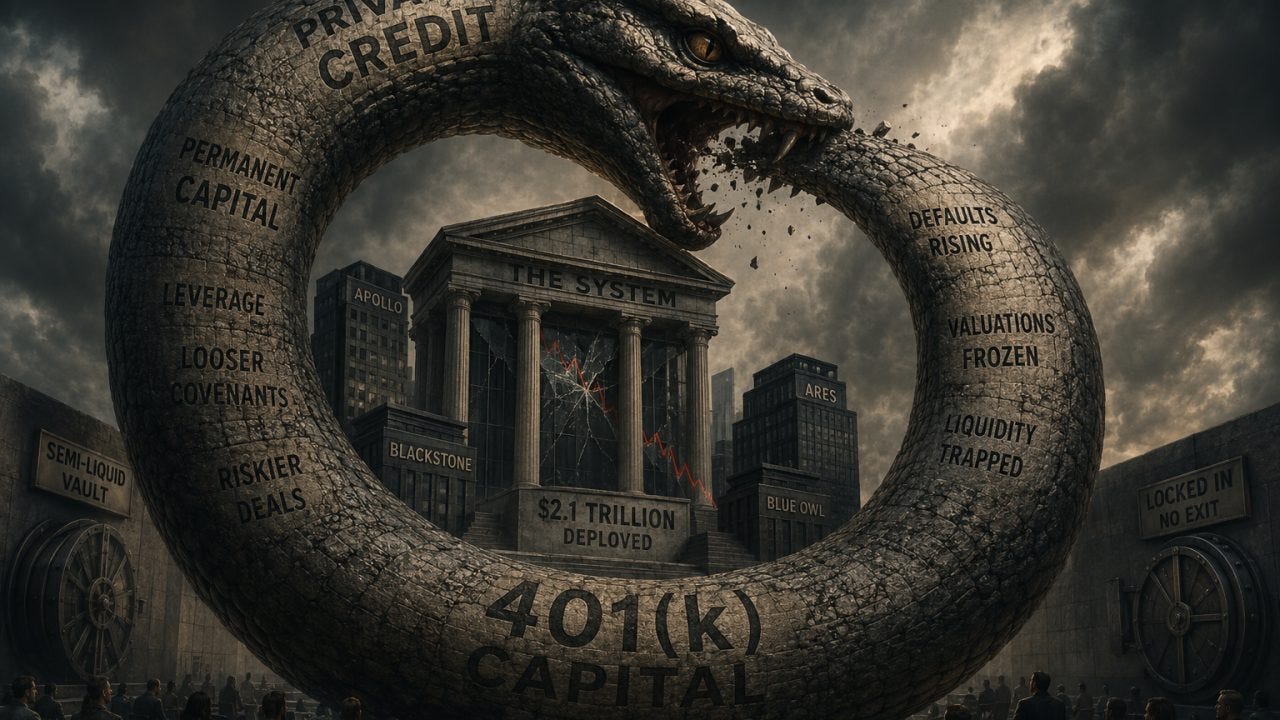
We all know that line in every disaster movie when someone realizes the thing they built is about to kill everyone, and they have to shut it down. Everyone turns to look at them like they want to breathe underwater.
Where we are now, nobody is saying a word. Everyone is quietly checking their portfolio.
How We Got Here
Let's go back to 2008 when the banks nearly killed the world. Out of concern, Congress and the Fed decided that the banks should never have to make a loan again that had any risk to it. Thus, the banks retreated into themselves and left a massive hole in the economy.
Into that hole walked private credit. For a seven-year window, from 2009 to 2015, private credit functioned as it was supposed to: as a loan option for companies banks would not touch. It worked so well. Investors earned returns. Companies received the loans they needed. Everyone was happy.
Then $2.1 trillion dollars showed up.
The Trap of Scale
How to Turn Good Decisions Into Catastrophes
The truth is, private credit investors could not deploy their $2.1 trillion dollars the same way they did when there were $2.1 trillion dollars worth of lending opportunities.
They did not stop. They could not stop. The structure of private credit would not allow for a halt in the lending efforts. They had permanent capital. Their investors would have nowhere else to put their money. Their analysts would be out of work if they did not deploy the capital. And the CEO would be remembered for nothing if the private credit firm did not grow its assets under management.
You deploy anyway.
Worse and worse deals. At the same prices. With higher and higher leverage. With looser and looser covenants. By 2016, the firm managing $2.1 trillion in assets was buying corporate bonds from companies that would have been rejected by the first Tuesday in 2011. Companies whose founders would eventually land in federal prison.
This isn't about greed. It's about architecture. There is no off switch.
What the Math Looks Like When You Stop Pretending
The default rate for private credit is 2%. At least that's the number the guys in the suits on CNBC use to defend their industry.
The real default rate in private credit is 5.8% as of January 2026. That's with PIK loans (these borrowers are bankrupt but we're pretending), liability management exercises (these are distressed borrowers we're calling a "restructuring"), and maturity extensions (these loans aren't default, they just never mature).
The highest on record.
But wait, there's more.
40% of borrowers have negative free cash flow. What this means is that 4 out of every 10 companies in the private credit portfolio do not have enough cash coming in to cover their expenses. They only exist because of the loan company. Financial zombies. The loan company will continue to lend them money because the math of the deal requires it.
In 2021, borrowers with negative free cash flow were 25%. It has doubled in four years.
6% of the loan portfolio switched to PIK financing by amendment in a single quarter. The lender said, "Yeah, you can't pay the interest. You know what? Don't. Just pay us more principal."
Software is 40% of the private credit portfolio. Wolfspeed filed for Chapter 11 in June 2025. Fat Brands in January 2026. Sunnova, Tricolor. Companies that made perfect sense with 0% interest rates look like suicide with a 5.5% interest rate.
Finally, over $160 billion in private credit loans are maturing in 2026 and will have to refinance at interest rates that make the 2020 LBO market look like a fever dream.
The Physics of Locking Everyone in a Vault
Here's where it gets weird.
The system no longer makes money. It takes the money that it does make and puts it somewhere else instead. It gives money to other people's money.
New money is needed to deploy the money that was earned by the old money to new money. New money sees this and begins to envision the old money as happy with how they are doing with the returns that they are earning, so new money writes a bigger check.
This system works so long as there is new money showing up with a check.
New money in Q1 2026 looked at its statement of where their money was returning and wondered: "Where the hell is this money from?"
$20 billion in redemption requests hit in the same week.
Blue Owl, Apollo, Ares, BlackRock, Morgan Stanley.
All of them. All of them were gating redemptions within weeks of each other.
At Blackstone's size alone, they could have written a $400 million check out of their own pocket to ensure every single request for redemption was met.
Everyone else? They locked the doors.
Only 40-45% of the requested capital from the various platforms came back.
At Blue Owl's OTIC fund, it was 12%. If you requested your money for the quarter, eight times out of ten, you were told no.
And yet, the investors accepted it. Just... accepted it.
They sat back and took the decision as reality.
They watched as the marks continued to move forward with the companies despite the deterioration of their investment portfolio.
There was no way out.
Locked capital is the perfect capital for a system that's quietly breaking. They can't panic. They can't flee. They just have to watch.
How to Feed a Monster: The 401(k) Scheme
When the system began to dry up, and credit began to deteriorate at a pace that would make the most seasoned 2008 crash analysts weep, the machine needed new blood.
On August 7, 2025, an executive order was issued granting private credit access to 401(k) plans.
Five days later, regulators would drop guardrails around private credit funds.
Six months later, the Department of Labor would propose a rule requiring fiduciaries to evaluate liquidity and valuation independently. A requirement that, by its very architectural design, was meant to fail if the fund was to be semi-liquid.
Now here's what kills me: the timing.
The door opens when the capital is drying up, when the gates are locking, when the credit is deteriorating the fastest, when the market is desperate for permanent capital like never before.
Roughly $10 trillion in 401(k)s. Payroll every two weeks. Thirty year lockup. No panic. No redemption. Can't leave when the marks compress.
The system found its next meal. And the meal can't run.
The Ouroboros Problem
What does a system that requires infinite inflows of capital look like when it runs out of capital?
It eats itself.
Literally. Not metaphorically. The ouroboros is upon us and no one is looking.
Public credit funds mark every day. BXSL hit a six-year low. Reality, laid bare in real-time. The semi-liquid funds that hold the same loans only mark every three months in a committee room where everyone seems to agree not to ask too many questions. Same assets, different level of accountability. One lives in the sunlight. The other lives in a vault.
When the capital doesn't come in and the vault door is opened, the gap will be seen.
The first wave of returns was created by the credit performing and the money coming in surpassing the money going out.
The second wave of returns was created by the same occurrence but with thinner returns.
The third wave of returns that is currently flowing into 401(k)s was created by the forced sale of assets by the organization that owns the funds.
It's not generating returns. It's liquidating itself to pay for yesterday's promises.
The Timeline Nobody Wants to Discuss
UBS did a scenario of what would happen if 15% of the companies defaulted on their loans. This was done by credit analysts who believe that 15% of private loan companies will default on their loans.
The 2021-2022 vintage of private credit companies have only 1.6x interest coverage. This is not a comfortable figure and only sufficient for periods of stable interest rates.
40% of these loan companies have negative free cash flows. Again, I stress this point as much as possible. These companies do not have the financial strength to operate independently of the continued lending to them.
Over $160 billion of private credit matures in 2026. They have to refinance at the current rates. Good luck.
When the default wave hits the system, they will need capital to extend these loans. The capital will have to come from somewhere. If it comes from thirty years of 401(k) contributions, the system will eat itself.
The returns will compress. The marks will deteriorate. The locked in capital will sit and watch it happen.
That's when it will eat itself up. Not when the market crashes.
The Pattern
I've seen this pattern three times before. 1998 was the first time. 2008 was the second time. And the economic bubbles that came before those two events.
Any system that requires exponential growth and can't say no to lending will eventually reach a point where it can no longer grow. At that point, the system is left with only deteriorating assets and promises they can no longer keep.
The scale of this market is different. $2.1 trillion has been deployed into this market. Roughly $10 trillion has been locked in 401(k) plans for thirty years of payroll contributions. A capital that cannot leave the system even if the individuals in those plans would like to exit the market.
This one will too.
And all of them that are currently locked in will watch as the system eats itself up.
Get Behind the Yield free by email. Short enough to read before your first meeting, specific enough to use in it. Subscribe here.
Need CE hours? Six self-study bond courses, accepted by CFP Board. See the courses.