
Behind the Yield
Behind the Yield: April 3, 2026
THIS WEEK: The Floor That Disappeared
Fixed Income Intelligence for Financial Advisors
Week of April 3, 2026
THIS WEEK: The Floor That Disappeared
There is a reason that private credit was an institutional asset class for several decades.
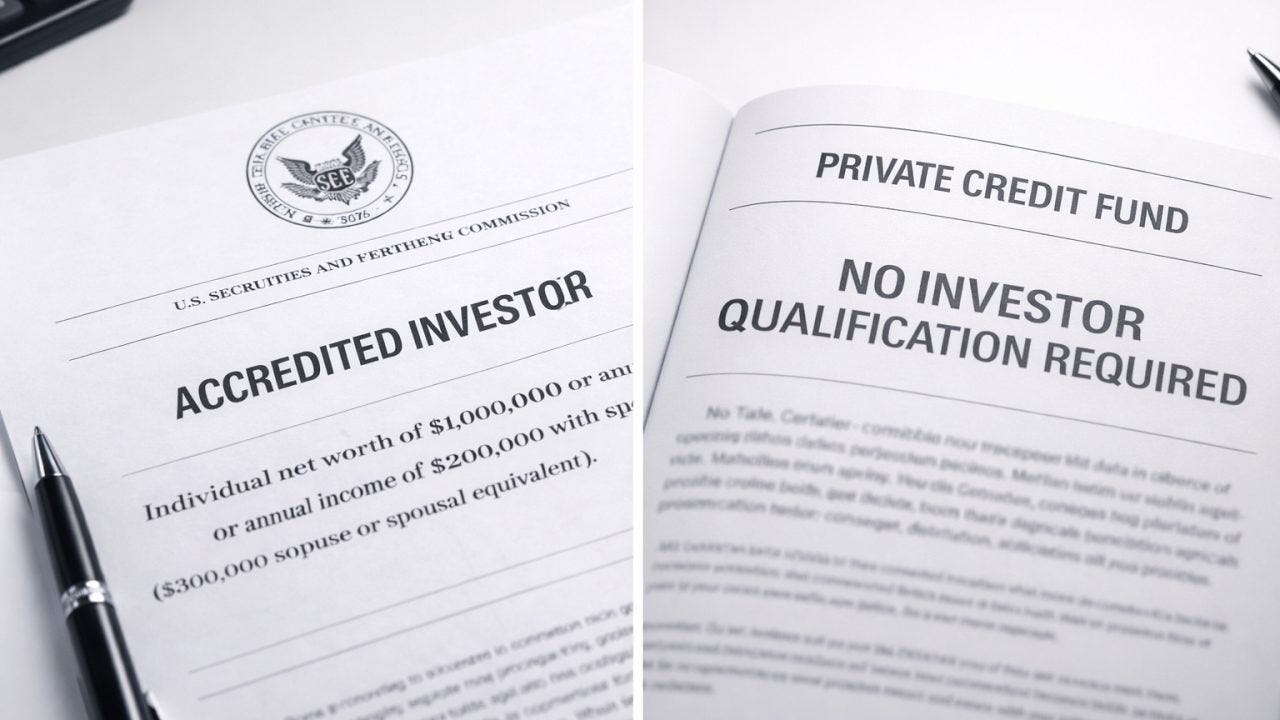
The SEC built a floor for this, requiring accreditation. To become accredited, an investor must either have net worth of one million dollars, excluding the primary residence, or have an annual income of two hundred thousand dollars. The SEC established this threshold for a reason. For years, they saw individual investors losing money on products they did not understand. They were tired of the paperwork. So they built a floor. If you cannot clear this bar you cannot play.
Currently, twenty four point three million United States households clear that bar. This is 18.5% of all US households. While this is not every household, and while it is not the majority of all households, this particular subset of investors meets the required financial profile for private credit.
Over the past several years, two things have happened to this accreditation floor. One fund eliminated it entirely. The other lowered it so dramatically that the threshold became a speed bump. The result of both decisions is that there are more retail investors going into illiquid private credit than the SEC framework was built to accommodate.
Here is how each of them did it.
The first of the two is Cliffwater Corporate Lending Fund, or CCLFX. This is the largest interval fund in the private credit industry. CCLFX reached a peak of thirty three billion dollars and had a compound annual growth rate of forty six percent from the time that it launched in 2019 to the time that it peaked in 2025. At the height of the fund's growth, Cliffwater released a press release to announce that they were becoming the leading democratization of private debt to the individual investor. They were not wrong about the democratization part, but they left out the cost of it.
Cliffwater did not lower the accreditation threshold for investors. Instead, they eliminated the requirement altogether. The way that they did this was through a registration decision. Under the Investment Company Act of 1940, private funds use the exemption to require accredited investors only. By registering the fund, Cliffwater eliminated the accreditation requirement. The floor did not lower. It disappeared.
The fund opened to every retail investor in America who had a financial advisor.
One layer of protection. One layer between retail investors and thirty three billion dollars of illiquid loans. That layer had every financial incentive to recommend this investment to their clients.
At its peak, Cliffwater was collecting approximately three hundred million dollars per year in management fees from retail investors. This is through a structure that legally bypasses the protection that the SEC built for this type of product. Seventy five people. Three hundred million dollars a year. One structural decision.
The second is BlackRock's HLEND, the HPS Corporate Lending Fund. Twenty six billion dollars in capital raised, and now a gated fund.
While Cliffwater eliminated the accreditation floor entirely, BlackRock kept a floor but moved it so low it stopped functioning as protection.
To invest in HLEND, an investor had to show net worth of two hundred and fifty thousand dollars or have an income of seventy thousand dollars and a net worth of seventy thousand dollars. The standard accredited investor requirement is a net worth of one million dollars. Thus, the HLEND threshold is one quarter of the standard.
Between forty and fifty percent of all United States households meet this threshold. This means that there are fifty to sixty five million American households that qualify. The threshold for accredited investors covers only 18.5% of all United States households. Thus, HLEND now targets more than twice the number of investors.
The minimum investment for HLEND was two thousand five hundred dollars. You could put less money into an illiquid private credit fund than you can spend on a used iPhone. This fund raised twenty six billion dollars. Now gated, and the number of investors that invested at or near the minimum is not publicly available.
Two different strategies, two different structures, the same destination.
Blue Owl's flagship fund saw redemption requests for 21.9% of its shares in Q1 2026. The technology fund received redemption requests for 40.7% of its shares. Both funds honored 5% of those redemption requests. Cliffwater capped at 7% against 14% in requests. BlackRock capped at 5% against 9.3% in requests. Goldman Sachs projects the retail private credit sector could shed between forty five and seventy billion dollars over the next two years.
The gates are up and investors are trapped behind them.
This is not an argument about credit quality. This is an argument about architecture and who benefits from it.
The accreditation requirement was built by the SEC because not every investor is equipped to take on every type of investment. The complexity and illiquidity of such investments can have real consequences when the investor needs to exit at a moment the product was not designed to accommodate.
Cliffwater built a structure that legally bypassed that protection entirely. BlackRock built a structure that maintained the appearance of a threshold while moving it so far down the income and net worth ladder that the protection it offered was largely cosmetic. Neither did anything illegal. Both disclosed their structures fully. Both raised tens of billions of dollars.
The question is not whether the gates were disclosed. They were. The question is whether the pool of eligible investors was constructed to benefit the investors or the fund.
That question does not have an obviously correct answer.
But it is the right question to be asking right now.
Show me the incentive and I will show you the outcome.
— Charles Urquhart, CFA
Fixed Income Resources | fixedincomeresources.com
Get Behind the Yield free by email. Short enough to read before your first meeting, specific enough to use in it. Subscribe here.
Need CE hours? Six self-study bond courses, accepted by CFP Board. See the courses.