
Behind the Yield
The Yield Is the Brochure
A borrower stops paying. There's no partial payment, no late payment. The borrower sends the fund nothing, and everyone who needs to know already knows that nothing is going to continue to come.
The fund deems this a good quarter. There's no fraud, no hidden terms, no illegal activities in this sentence. In fact, this sentence exists within approximately one in ten of the loans that your clients hold. The Boston Fed went and counted. Before the clever part of the equation, the plain part is exposed: the check that your client cashes every quarter does not necessarily equal the interest that the fund collected from the borrower.
Start with the rule that makes a BDC a BDC. It pays no corporate tax. Instead, it must hand 90% of its income to shareholders each year. That's the deal. That's the reason the organization exists. Your client did not purchase a BDC to gain exposure to the world of lending to mid-market HVAC distributors. She purchased the check. The check is the product. The rest is the brochure.
Ask the dumb question, the type that a ten-year-old asks when he's about to be told that he must eat his potatoes. Where does the money in the check come from?
For about a decade the answer was too boring to bother with. Fund lends to company, company pays interest, fund pays shareholders. Manager's at the club by lunch time. Nothing to see.
Then there was something to see.
Not All Income Is Money
Everywhere else in the economy, income is money. But in private credit, income and money have filed for divorce.
Borrowers are underwater and can't pay the coupon. Lenders can mark loans down or drop them to non-accrual status. Both moves wreck the quarter. Which is why nobody wants to be the honest lender.
Or there's the third move, and you have to respect the engineering. Rewrite the loan so the interest gets paid in kind. The borrower doesn't fork out a cent. He just agrees that the coupon on the loan he's not paying gets attached to the one he's got. He pays nothing, he owes more, and the lender puts the nothing on his books as income. Zero came in. Income went on the statement. And the borrower is in worse shape than he was last quarter.
It's like a bathroom scale that adds a pound every time you skip the gym and then congratulates you.
Again, not a short-seller's talking point. The Boston Fed pulled the numbers from 168 BDCs. The percentage of loans with PIK went from 6% in early 2022 to 10% in early 2026. That's a 67% jump in three years. The percentage of construction loans using PIK went from under 5% to nearly 20%. Software loans doubled. Fitch has discovered that PIK is 8.1% of the industry's interest and dividend income in 2025. That's up from 7.7% the year before and well above what the industry put up before 2020.
According to the industry rule, 90% of the company's income is going out the door every year in cash. Except a growing percentage of that income is not in cash. But the dividend is real money hitting your client's account every quarter. So where is the company's cash coming from if it's not coming from the loans they make?
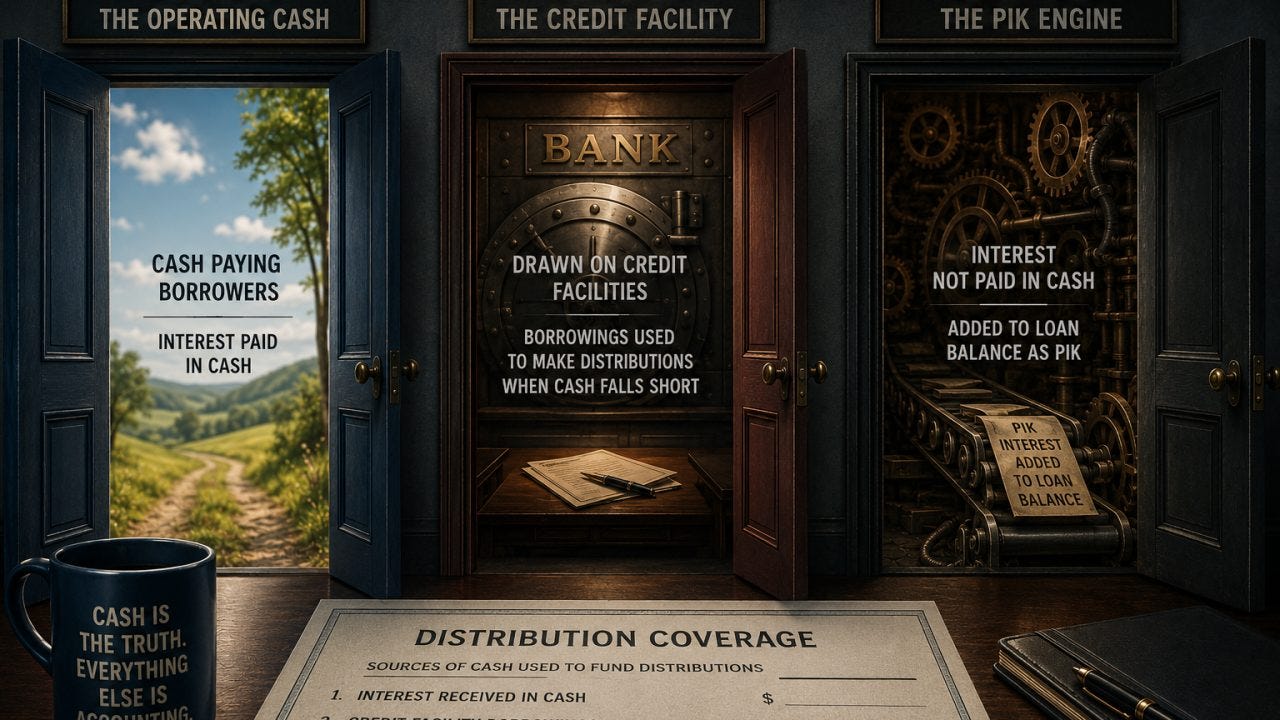
Three places, in fact. Follow one dollar as it exits the company and it will touch all three. The first place is fine. The other two are why I'm at the keyboard instead of somewhere with a view.
Door One: The Honest One
For a good fund, this is the whole story and the end of it. There are hundreds of borrowers and most of them pay the interest using cash, your grandmother's way. The interest payment makes up the dividend payment. For the best shops, this is the real picture.
Ares has north of 600 borrowers on the fund and hasn't touched its distribution yet. The earnings easily cover the fund's check. Blackstone's traded fund, BXSL, comes in at around 97% first-lien. That's the top of the stack. First in the lifeboat. You know this. The fund collected more money from borrowers repaying their loans during the last quarter than it lent to new borrowers during that quarter. These funds have a few PIK loans jostling among a sea of paying borrowers. I don't lose a minute of sleep over these funds.
The trouble begins the second the loans stop covering the check on their own. The fund has to make a decision that it does not want to make. Cut the dividend? Never. All of the investors will see it the same day. For a non-traded fund, the dividend is the only promise that the fund makes to its investors. By cutting the dividend, the fund is essentially stating that the product that it offers does not work. Where else can it turn for the funds that it needs in order to even continue providing for its investors? Into the bank. Door two.
Door Two: The Bank
Having access to the bank's money is not a sin. Using the bank's money to even out a particularly shaky quarter's earnings is normal and acceptable. But if a fund is taking out a loan from the bank to pay a dividend that its earnings cannot provide for the fund any longer, then it is using the bank's money to pay its shareholders. In the account, the same word will adorn the bank's money as the yield that the fund produces for its investors. The same word, but not the same thing.
And there's all sorts of stuff that you can't see because it's off the balance sheet. Reuters recently ran the numbers for the fourteen BDCs that chose to disclose their joint ventures and the debt that they carry that they don't include on the balance sheet for those joint ventures. The result was an 80% increase in borrowing across 2025, and an additional 14% in the first quarter of 2026. Nobody broke a rule. That's the point. It's legal, it's disclosed in their financial statements, but everybody just ignores it like it was never written. It doesn't show up in the leverage ratio on the fact sheet. Bank commitments to BDCs started at around $10 billion in 2013 but grew to north of $50 billion in 2025. Now, all of a sudden, the banks are imposing tighter terms on the loans that they make to BDCs while the BDCs are begging for more money.
Every bank has a ceiling. When you reach the ceiling, the well is dry. One door left.
Door Three: The Next Guy
The next investor. That's the door.
Every month, another subscription check clears. It does not have to go into loans. It can just as easily go into the fund's dividend to the investors who wrote their checks last quarter. The dollar that walks in the door this morning to buy shares in the fund can just as easily walk right back out this afternoon as the fund pays another investor's dividend.
The fund's loans came in short that quarter. The bank was tapped out of funds. The dividend has to be funded by the check that just cleared this morning from the next investor in line, the guy who thought he was buying loans. He's booked his return. The last investor walked out with his check in hand and went home. Around it goes.
There's a word for the distribution a company makes out of its new subscriptions. I'm not going to type it out in the article because half of you are probably going to quit reading the article to have a debate with me about whether or not that's fair. You know what I'm talking about. Your clients know what I'm talking about.
It's in the sources and the uses. It's in the return of capital line item. It's in the prospectus. It's in the 10-Q report. It's disclosed. It just never makes the trip from the footnote in the 10-Q report to the one line item on the client's statement. Homework. Nobody does the homework.
The Machine Only Runs While the Checks Come In
The machine has one particular weakness. It only ever runs when money comes in. In 2026, the money stopped coming in.
For the first time ever, BDCs that did not trade their shares paid out more money than they took in. Stanger, a company that tracks BDC fundraising, reported that industry sales dropped by more than 40% from the previous quarter. By April, fundraising for those funds was off by about three-quarters compared to the same period the previous year. The funds have a 5% exit gate for investors. In the second quarter of 2026, investors requested $15.6 billion in exits from the funds. In ten of the sixteen funds that Fitch tracks, requests for exits blew past the 5% exit gate. In one of the larger BDCs, requests to exit hit nearly 40% of the fund's shares, against the 5% gate. Rather than receive the money that they requested, the investors got their sliver of the money back along with the confirmation that they were next in line for the following quarter.
The gate, by the way, was never built to protect you. One investor heading for the door is nothing. A crowd hitting the door at once is what kills a fund like this, and the gate is what keeps the crowd off the door.
The cash is draining from both ends at once. Fewer checks come in through the front end. More hands claw at the back end. The numbers are reflecting that. Reuters went through 53 BDCs. 28 of them lost money in the first quarter of 2026. That's up from 12 a year earlier. Where there used to be a profit average for the first quarter of 2025, there's an average loss for the first quarter of 2026. Fitch said the private credit default rate is at a record 6%. The tide is indeed going out. Who forgot to wear the shorts?
How You Tell Them Apart
Both funds will tell you the same yield. The honest one and the other one have the same number on their fact sheet. You could stare at that for all the days in your life and know nothing. So don't look at the yield.
Ask four questions of the funds instead.
The first question is about the PIK. What percentage of last year's income was PIK, and in what direction is that figure moving? The industry rate is already north of 8%. iCapital, the company that sells these funds, says the number is 10%. If a fund crosses that line, according to the company, it can start to develop liquidity problems. Why? Because of the 90% rule. Every year, the fund must pay out 90% of its income in cash to the fund's shareholders. That's regardless of whether it collects that money in cash during that period. So the absolute level of the PIK is less important than the direction of the number.
Question two. What's the non-accrual rate? Is that climbing right alongside the PIK? Watch those two rates climb alongside each other. If they're climbing together, it means the PIK is not bankrolling a rocket ship of borrowers who are paying you back double on your loans. Instead, the PIK is financing the borrowers who are not paying back the loans anymore, and who are not going to start.
Question three. What has the NAV per share done? The PIK does hold NAV per share up with the interest that isn't being paid by the borrowers. But the losses in the company's value are not vanishing. They just show up later. So NAV per share going up while the credit quality goes down is not a great sign for the company's value. It just means the bill has not yet come to the company's mailbox.
Question four is the one that ends the meeting. Is the distribution based on the cash that the fund collected, or on accruals, borrowings, and the subscription checks that cleared this morning? One fund will answer frankly and without hesitation, while the other will go quiet, or one will have to rush out to write a footnote. The pause is the answer.
The industry's fair comeback: all of this is disclosed. And it is. Every number is in a filing somewhere. Yet disclosed and read are two different things. The statement will tell you the yield of the fund, but never from where the yield came.
That's the whole thing. The yield used to tell you how much the fund earned. Now the yield tells you whatever happened to land in the account. The same number, the same word, but no one had to lie. The yield is the brochure. The four questions are the diligence. On paper, it's the same as the other fund. Follow the money to the door and they're no longer the same.
If you own one of these funds, or you put a client in one, which of the four questions can it answer without a pause?
Disclosure: The views expressed here are my own and are for educational purposes only. This is not investment advice or a recommendation to buy or sell any security. Funds named are used as illustrations, not as endorsements or criticisms.
Get Behind the Yield free by email. Short enough to read before your first meeting, specific enough to use in it. Subscribe here.
Need CE hours? Six self-study bond courses, accepted by CFP Board. See the courses.