
Behind the Yield
They Got Paid Twice
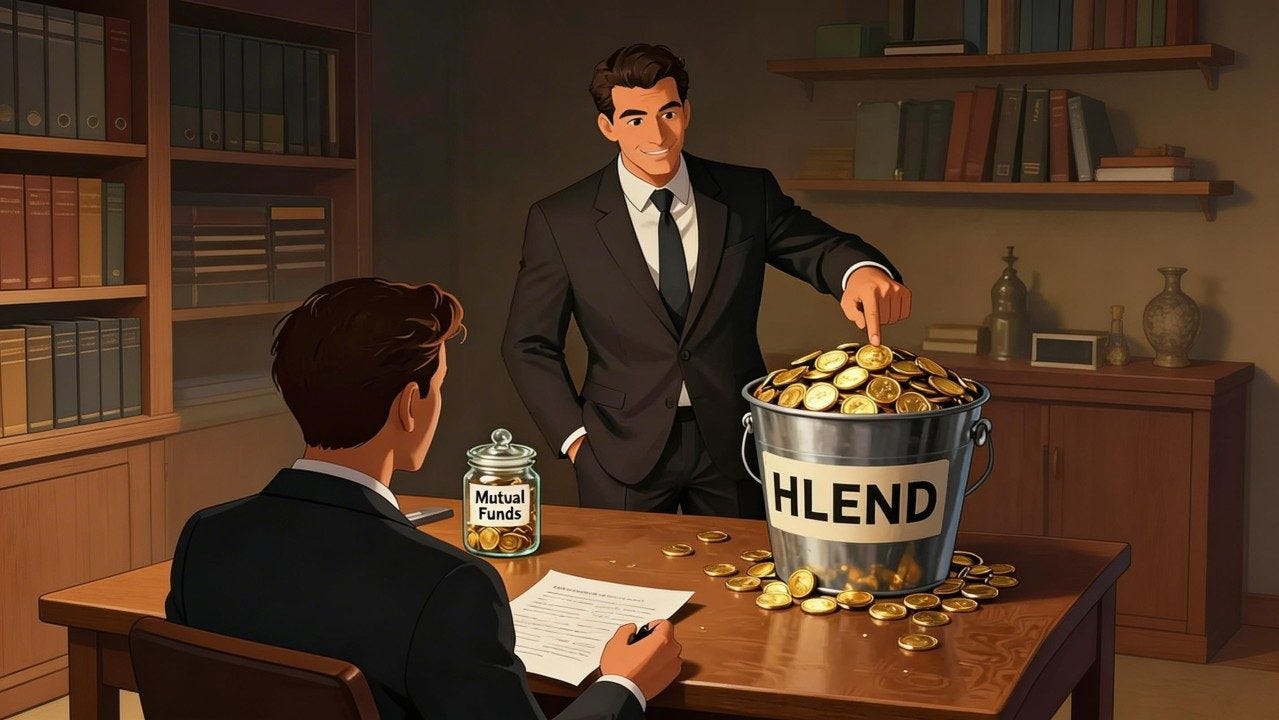
This is part two of a three-part series on the distribution mechanics of HLEND, one of the largest non-traded BDCs in America.
Part one of this series asked the question: Who is the Founding Distributor? Nobody answered.
Part two of this series is about what I found when I was waiting.
〰〰〰
In 2019, Park Avenue Securities, along with 78 other firms, was found to have placed clients into mutual fund share classes at a higher cost than necessary. The firm paid a penalty of $508,083 in addition to $56,184 in prejudgment interest. The SEC found that Park Avenue had failed to tell their clients of the conflict of interest.
The violation of the rule was simple; there was a cheaper share class available for the same mutual fund, but the client was placed into the more expensive share class by the firm.
Five years later, the firm is doing the same thing — but this time it is legal.
〰〰〰
I want to tell you why I write about this.
I do not have any short positions on any of these funds. I do not have any clients in any of these funds. There is no lawsuit pending. No complaint has been filed with the regulators. I have no financial interest in the outcome of any of these funds.
I teach sophomores and juniors at a business school in Baltimore. Over the past 30 years, I have worked in the fixed income business with companies such as Kidder Peabody, Lehman Brothers, Fidelity, and Tradeweb.
Recently, I published a piece that looked into the identity of the Founding Distributor of HLEND. To this date, the identity of the Founding Distributor remains unknown.
Today I want to share what I found out about what happened to the money.
Not the trail money. The other money.
〰〰〰
Let's start with the share class.
On February 3, 2022, HLEND broke escrow and sold 20,437,880 shares. Of these, 12,095,600 were Class F shares, which is the exclusive share class that the Founding Distributor received. This comes to 59% of the initial share offering to one firm.
Class F shares carry a 0.50% annual distribution and servicing fee. If we take $100,000 as an example, this means that $500 goes to the distributor every single year. Class D shares, which are available to fee-based advisors, carry a 0.25% annual fee. For the same amount, the fee is half as much.
A trail is an ongoing annual fee that is paid to the distribution firm as long as the client continues to invest in the fund. The structure chose the share class before the advisor ever got the chance to speak to the investor. Park Avenue Securities was authorized to sell Class F shares. This is the share class that Park Avenue exclusively distributed. The client did not choose it. The advisor did not choose it. The institution did.
Now here is where the comparison with the 2019 violation becomes impossible to ignore.
In 2019, there was a violation because a cheaper share class was available, and the client was placed into the more expensive share class. In 2024, Class D shares exist at half the cost of Class F. The client was placed into Class F shares. The firm that collects this fee is, once again, the same firm that the SEC sanctioned five years earlier for doing the same thing in a different product wrapper.
In 2019, placing clients into a more expensive share class to benefit the firm was illegal. In 2024, there is no regulation to prevent this outcome in the context of non-traded BDCs. There is no requirement for a BDC to name its founding distributor. There is no Share Class Selection Disclosure Initiative to regulate alternative investment products.
The mutual fund channel was regulated. The BDC channel was not.
〰〰〰
Now here is the first layer the investor never saw.
Six days after HLEND broke escrow on February 3, 2022, The Guardian Life Insurance Company of America announced that it had acquired a minority equity stake in HPS Investment Partners, the firm that manages HLEND.
In the financial world, six days is not long enough to open a brokerage account. But it is apparently long enough to announce a strategic equity partnership with the firm whose fund you just launched exclusively.
Guardian owns Park Avenue Securities. Park Avenue Securities is Guardian's captive broker-dealer and registered investment adviser with approximately 2,400 financial professionals that manage over $50 billion in client assets. In their ADV filed with the SEC, they list HPS Investment Partners as one of their revenue sharing partners. They receive the greater of $200,000 or 5 basis points annually on any assets that are held in HPS products.
In their own 2024 Community Impact Report, Park Avenue Securities named HPS Investment Partners specifically as one of their alternative investment solution providers. Their words. Their document. Their parent company's website.
The evidence points to Park Avenue Securities as the Founding Distributor. The six-day gap between the first trade of Class F shares and Guardian's announcement of a minority stake in HPS. The revenue sharing detailed in their own ADV. The active distribution relationship named in their own published report. The exclusive share class offered to fee-based wrap accounts — precisely the account structure Park Avenue Securities operates.
I cannot see the distribution agreement. It has never been made public. But Park Avenue Securities, Guardian Life, HPS, and BlackRock can see it.
They have not taken the opportunity to end this conversation.
〰〰〰
Now here is the part that kept me up at night.
On August 17, 2024, Guardian announced that they were increasing their minority stake in HPS and would be moving $30 billion of assets under HPS management. Four months later, on December 3, 2024, BlackRock announced that it was acquiring HPS for $12 billion.
Sometimes the timing is just timing.
On July 1, 2025, the acquisition was completed. BlackRock acquired 100% of HPS. Every equity holder was bought out.
Including Guardian.
Guardian took a minority stake in HPS six days after the first Class F trade. They increased that stake four months before the firm was acquired for $12 billion. BlackRock acquired 100% of HPS and bought them out.
The Class F investors paid 0.50% annually for the entirety of this period. That is double what every other fee-based advisor in the same fund collected.
Guardian got paid on the trail through its broker-dealer. They got paid on the equity through the acquisition of HPS by BlackRock. The retail investor in Class F shares funded the first payment. The growth of the fund they invested in funded the second.
They got paid twice.
〰〰〰
Here is what I want you to understand about all of this.
What I have described above is not illegal. The rules have been followed. The Class F trail is mentioned in the prospectus. The existence of the Founding Distributor is mentioned in the prospectus. Guardian's minority stake in HPS was publicly announced. The acquisition of HPS by BlackRock was publicly disclosed and approved by the shareholders.
Every individual has done what they were supposed to have done.
Yet the client that purchased HLEND Class F shares did not see any of this.
The investor did not know that their advisor worked for the firm the evidence points to as the Founding Distributor. The investor did not know that the Founding Distributor's parent company held equity in the fund manager. The investor did not know that the value of that equity increased with the growth of the fund. The investor did not know that equity was bought out by BlackRock.
The investor sees a number written in the prospectus. They put their trust in the advisor. They invested.
In 2019, Park Avenue Securities was held accountable for placing clients into higher-cost share classes without disclosure.
In 2024, the evidence points to the same firm, the same structure, and the same outcome.
The regulatory framework is the only thing that changed.
This is not a crime. It is something else.
〰〰〰
"Show me the incentive. I will show you the outcome." — Charlie Munger
〰〰〰
The trail and the equity are only part of the story. Part three of this series will examine who built the shelf this product sits on — and who owns it.
〰〰〰
The author holds a CFA designation and teaches fixed income classes at Loyola University Maryland's Sellinger School of Business. He is the founder of Fixed Income Resources. He does not have any financial interest in the funds or companies mentioned in this article.
Get Behind the Yield free by email. Short enough to read before your first meeting, specific enough to use in it. Subscribe here.
Need CE hours? Six self-study bond courses, accepted by CFP Board. See the courses.