
Behind the Yield
Unnamed by Design

Every month, somewhere in America, a retail investor opens a statement and sees a distribution check.
They take this as proof. Proof that the investment is working. Proof that someone, somewhere, is paying attention to their money.
Most of the time they are right.
Sometimes they are not.
This is a story about one of those times. But it is also the end of a longer story.
Several weeks ago I started pulling on a thread. The thread was a share class called Class F. As in Founding. Created exclusively for a single unnamed firm that raised $5.9 billion for a private credit fund called HLEND and collected between $37 and $40 million in fees over four years. In four years of SEC filings, that firm was referenced dozens of times and never once named.
I wanted to know who it was.
What I found was not just a name. It was the machine behind the name. The entire distribution architecture that moved an institutional product into retail accounts, collected fees at every level, and left the liquidity risk with the investor at the bottom.
This is that machine.
The fund is called HLEND. The HPS Corporate Lending Fund. One of the largest non-traded Business Development Companies in America, now owned by BlackRock. On March 7, 2026, $1.2 billion in redemption requests arrived at the gate. BlackRock returned approximately $600 million. The rest were told to wait.
The checks stopped coming.
What the investors did not know, and could not have known from the documents they were given, is that by the time each check arrived every month, everyone else had already been paid. Years ago, at subscription.
I want to show you who got paid first.
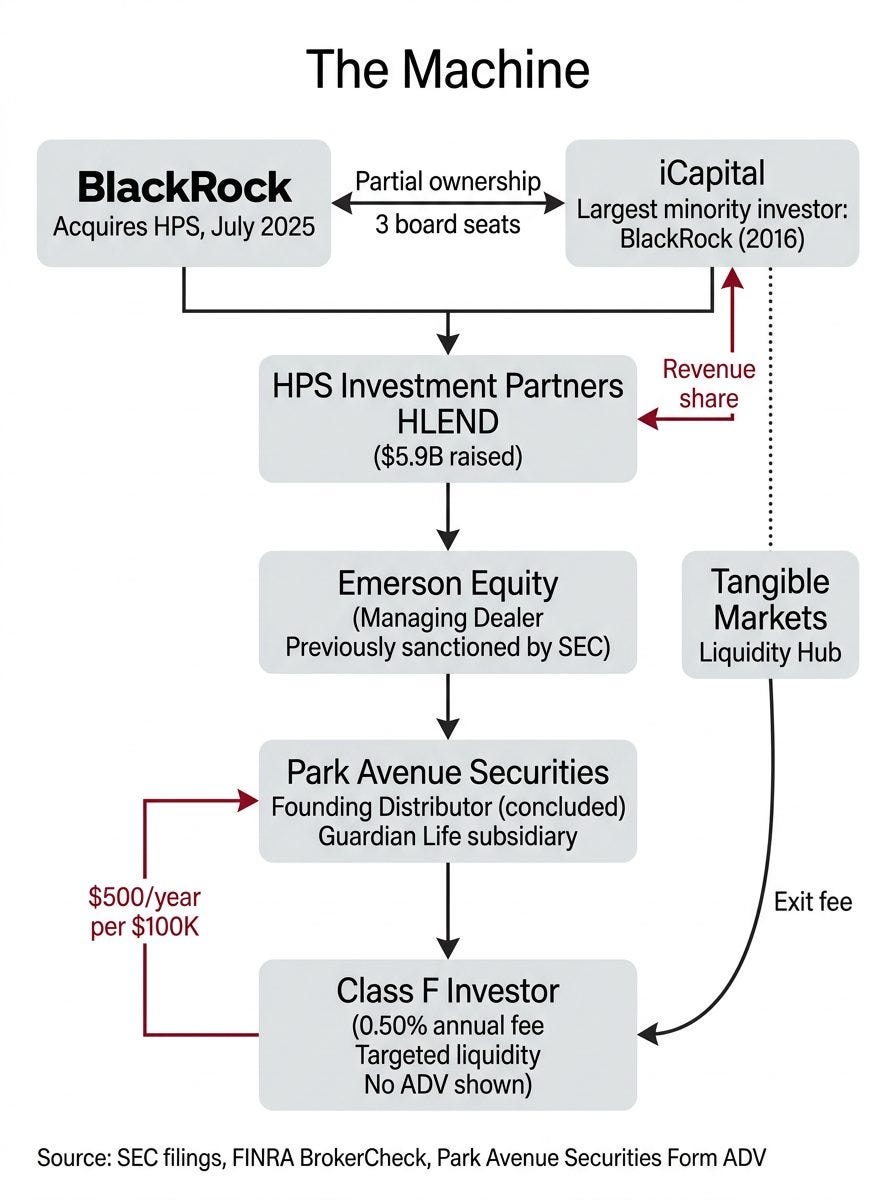
Take a look at this diagram.
ARROW ONE — PARK AVENUE SECURITIES
The investor first interacted with Park Avenue Securities. They are the financial professional that sold the investor the HPS Corporate Lending Fund. Park Avenue is the broker-dealer for Guardian Life Insurance Company of America. Guardian is a 165-year-old mutual company.
Park Avenue has over 2,400 financial professionals. They sell life insurance, annuities, and since 2022 have been actively selling BlackRock private credit through a share class specifically made for them: Class F.
Class F pays 0.50% per year. Class D pays 0.25%.
For every $100,000 that the investor puts in, $500 will go to Park Avenue each year. For Class D, $250 goes to the financial professional.
Neither investor knew the other existed.
Park Avenue Securities has 23 disclosure events on FINRA's BrokerCheck, as well as 20 regulatory actions from the SEC. [1]
Nobody showed the investor the Form ADV that listed this fee.
Nobody gets paid to show investors the Form ADV.
ARROW TWO — EMERSON EQUITY
Park Avenue Securities did not come to HPS on its own.
Above Park Avenue is Emerson Equity. This firm, known as the Managing Dealer, recruited the various broker-dealers to participate in the sale of the HPS Corporate Lending Fund.
In 2021, FINRA found that the firm failed to supervise one of its advisors properly. Between 2017 and 2021, the advisor collected $1.6 million in unnecessary fees from clients.
In August 2025, the firm agreed to a settlement with the SEC. The firm was the largest distributor of GWG Holdings L Bonds. When the company filed for bankruptcy, the bonds went to zero. Emerson settled without admitting or denying the findings. [2]
The firm that managed the retail sales of the HPS Corporate Lending Fund had been sanctioned for selling retail investors a product that became worthless.
That is not a conspiracy. That is a resume.
ARROW THREE — ICAPITAL
Above Emerson is iCapital.
iCapital is a technology platform and investment adviser registered in 50 states. This is the firm through which Park Avenue Securities and others distributed funds. [3]
iCapital is also partially owned by BlackRock. BlackRock has been the largest minority investor in iCapital since 2016. In April 2020, BlackRock increased its board representation to three seats. By 2025, iCapital's value was $7.5 billion.
The document that explains who gets paid to sell you what is the same document that nobody gets paid to show you. That document, Park Avenue Securities' Form ADV, lists HPS Investment Partners as a revenue sharing provider, paying the greater of $200,000 per year or five basis points on client assets. It also lists iCapital as Park Avenue's alternative investment platform. [4]
Each of the parties between the investor and BlackRock has a financial relationship with each of the others. All of it is disclosed. None of it is explained.
ARROW FOUR — HPS / BLACKROCK
At the top of the diagram is BlackRock.
In July 2025, BlackRock acquired HPS Investment Partners, the creator of HLEND. BlackRock already had a partial ownership interest in iCapital, the organization that distributed HLEND to retail investors.
HLEND stated in its filings that the firm that raised $5.9 billion for the fund collected between $37 and $40 million in distribution fees over four years.
This firm is never named.
It is called the Founding Distributor.
Based on the ADV, the prospectus, and the revenue sharing documentation, it is my conclusion that Park Avenue Securities is the Founding Distributor of HLEND. No one has confirmed or denied this.
BlackRock is a very sophisticated firm. They understand how this all works. The investor at the bottom of the diagram does not.
THE DOTTED LINE — TANGIBLE MARKETS
Look to the right of the diagram. The dotted line.
This was something that no one saw coming.
In September 2025, six months before the gate, iCapital made a strategic investment in a company called Tangible Markets. Tangible Markets operates a platform called Liquidity Hub. A secondary marketplace for investors in gated private funds to sell their positions.
iCapital's broker-dealer affiliate receives compensation for directing investors to this platform.
The same ecosystem that distributed the fund into illiquidity built a toll booth at the exit. The gate creates the problem. The affiliate sells the solution. The investor pays twice.
All conflicts of interest are disclosed. The ADV. The prospectus. BrokerCheck. Public documents, required by law, available to anyone with an internet connection and several hundred hours of free time.
This is not fraud. This is not a crime. This is an institutional product with a retail distribution problem. The system was designed to disclose conflicts of interest, not eliminate them.
The system was not designed to ensure that anyone asks.
The investor at the bottom of this diagram put their trust in the check that they received.
It was a real check. BlackRock is a reputable firm.
But by the time that check arrived each month, every other party had already been paid. The risk of illiquidity, the only risk that anyone involved had no financial incentive to explain, had been wholly retained by the investor.
Start at the bottom of this diagram.
Work your way up the arrows.
Each arrow represents a fee.
The investor is at the bottom of all of them.
Show me the incentive. I will show you the outcome.
[1] Per FINRA BrokerCheck, CRD# 46173. The SEC enforcement action referenced involved Park Avenue Securities LLC's failure to disclose conflicts of interest in connection with its receipt of 12b-1 fees and its selection of share classes for the funds that paid such fees. In the Matter of Park Avenue Securities LLC, IA-5138, March 11, 2019.
[2] The Managing Dealer for a non-traded BDC coordinates and manages the selling efforts of the various participating broker-dealers for that private credit fund. In the case of HLEND, the Managing Dealer is Emerson Equity LLC.
[3] iCapital, Inc. and its affiliates are registered investment advisers and broker-dealers. BlackRock, Inc. has been the largest minority investor in iCapital since 2016 and holds board representation.
[4] According to Park Avenue Securities' Form ADV, HPS Investment Partners is a revenue sharing provider, paying the greater of $200,000 per year or five basis points on client assets held in HPS products. iCapital and its affiliates receive fees based on assets distributed through their platform.
Get Behind the Yield free by email. Short enough to read before your first meeting, specific enough to use in it. Subscribe here.
Need CE hours? Six self-study bond courses, accepted by CFP Board. See the courses.