
Behind the Yield
Behind the Yield: February 12, 2026
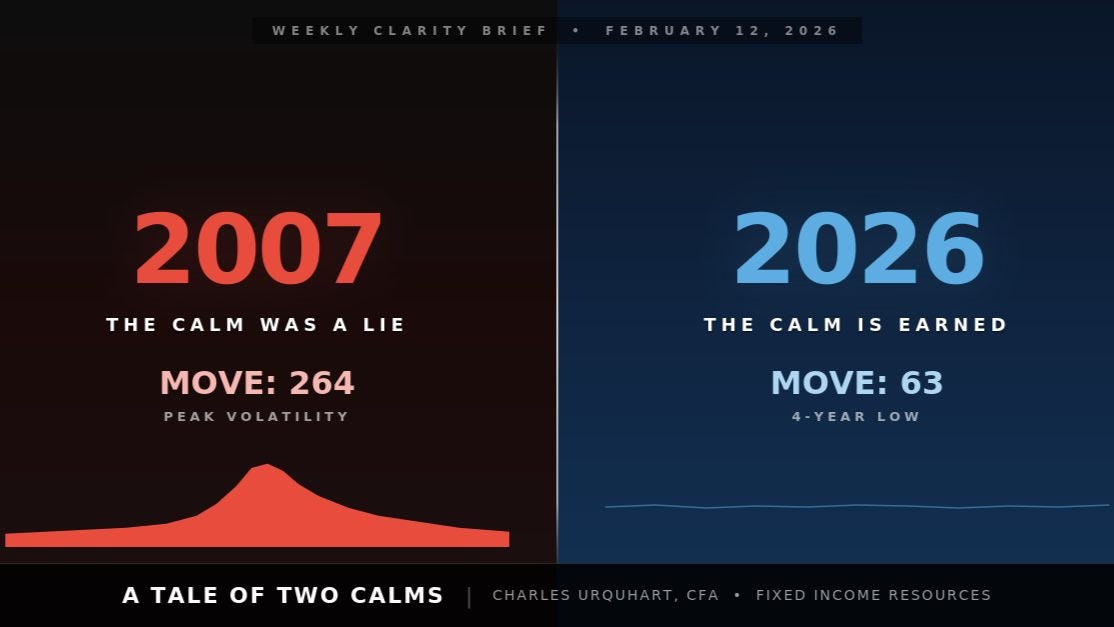
The last time the bond market was this quiet, I was sitting on a trading desk in Boston.
February 12, 2026
THE THEME
The last time the bond market was this quiet, I was sitting on a trading desk in Boston.
It was early 2007. The Fed had just finished hiking to 5.25%. On every desk on Wall Street, bond spreads were tight and vol was low. The soft-landing consensus was unanimous.
At the same time, subprime loans were being stacked in secret by mortgage brokers, bundled in silence by rating agencies, and sold with a smile by relationship managers. The seeds of a disaster were there, but the bad credit was invisible to almost everybody.
Within six months, Brookstreet Securities collapsed. Fidelity, as custodian, was fielding panicked calls from retail investors. Within a year, Bear Stearns was gone. Within 18 months Lehman was gone.
The MOVE Index (the bond market VIX) jumped to 264. Fear was back — and so was the Great Recession.
I am looking at the bond market today — and feeling the same quiet calm. Why so tight? Why so low? How is your stomach?
Before you go any further, slow down for a moment.
Let me make my case for why this time is different.
THIS WEEK'S SNAPSHOT
10-year Treasury 4.16%
Fed funds rate 3.50%-3.75% (held steady Jan 28; two dissenters wanted a cut)
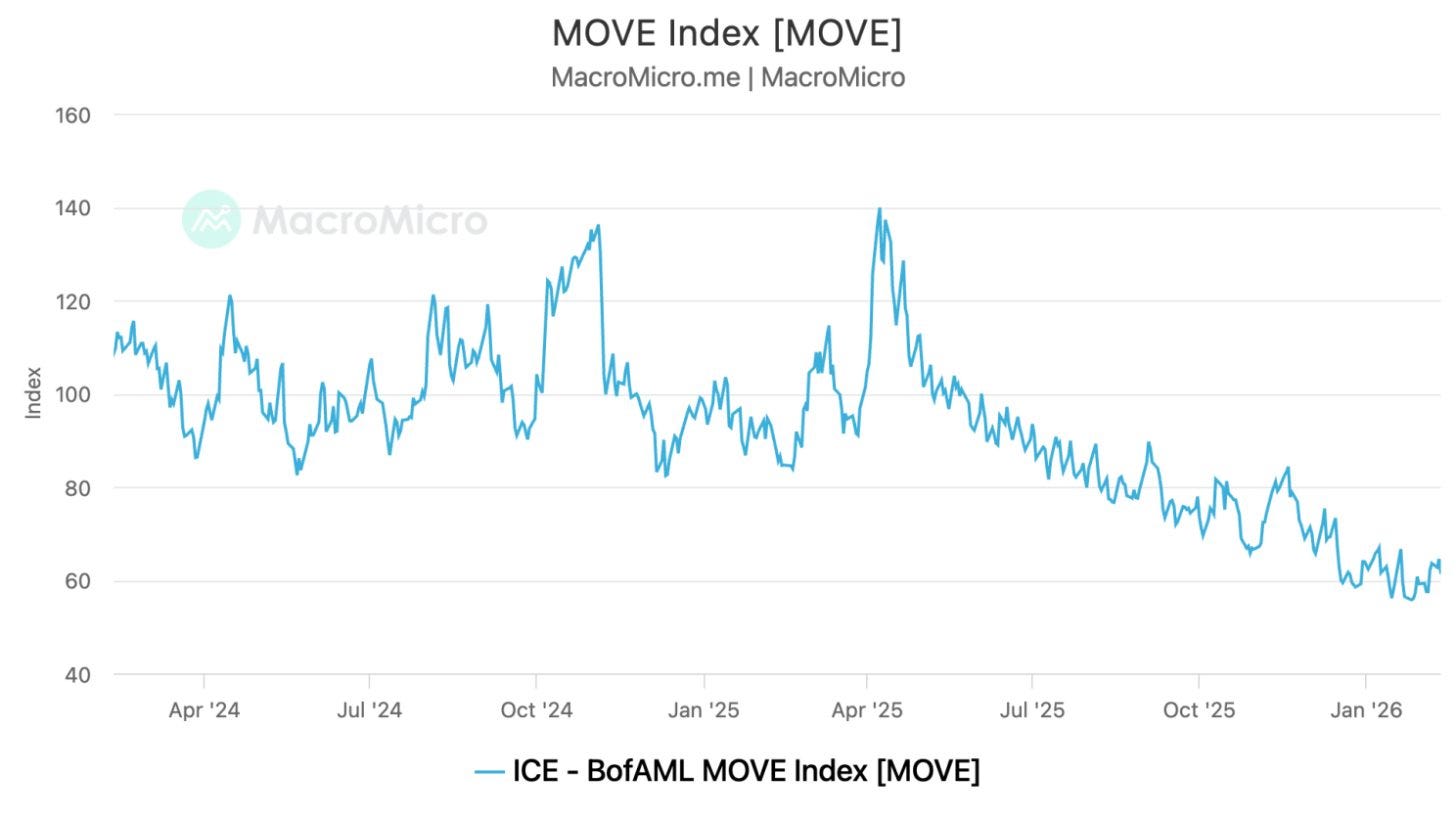
MOVE Index (bond market VIX) around 63 (down 55% from 52-week high of 140)
IG corporate OAS around 75 bps (tighter than 98% of last 20 years)
S&P 500 6,941
January jobs +130,000; unemployment 4.3%
Next Fed cut probability 48% for June
Market vibe Quiet. But the good kind of quiet.
2007 VS 2026: A TALE OF TWO CALMS
In early 2007:
Fed at 5.25% after aggressive hikes into a housing bubble
One-third of mortgages originated in 2006 were subprime or no-doc
Credit too-easy
Calm was basically a lie
In early 2026:
Fed at 3.50%-3.75%; easing cycle begun after pausing rate hikes
Unemployment low but not fake low
Corporate balance sheets clean and healthy
Calm is legit, backed by fundamentals
If you don’t believe me, I understand.
“This time is different” are the four most dangerous words in finance.
THREE SIGNALS THAT THE CALM IS REAL
Signal #1: Volatility has collapsed — and it makes sense.
The MOVE Index is at around 63, down 55% from its recent high of 140
The 10-year has traded in a range of just 39 basis points over the past six months — tightest range since October 2018
Not complacency, not asleep at the wheel
The market has done its homework. This is a boring low-volatility environment — which means it is probably a stable low-volatility environment.
Signal #2: Credit spreads are tight because credit is good.
IG corporate spreads sit around 75 bps — tight compared to historical average
High-yield spreads around 280 bps — nearly half their 30-year average
Professional pessimists have done their homework too. The credit analysts agree: the credit is healthy.
Signal #3: You are still getting paid.
Normally low volatility + tight spreads means low yields. Not right now.
The 10-year treasury yield is at 4.16%
IG corporates near 4.85%
Yield is in upper third of its 20-year range.
Bonds aren’t just cheap relative to history; they’re cheap relative to themselves
Low risk + strong return = rare opportunity
SPREADS ARE TIGHTER THAN USUAL — AND MAYBE THAT’S MY BIGGEST CONCERN
At about 75 basis points, IG credit spreads are as tight as they have been over the past three years.
Generally, when you’re paid less for risk, it’s not an ideal situation
But when you’re still paid a very attractive absolute yield (around 4.85% for IG corporates), it’s less of a problem
If you want to buy corporate bonds, tight spreads are not bad news
If you want to buy cheap corporate bonds, then tight spreads are definitely bad news; that’s essentially an oxymoron.
Spreads or no spreads: the conditions are better than they’ve been for a generation.
THE CASE FOR ACTING NOW VS THE CLIENTS’ REASONING FOR WAITING
Clients with investment-grade income accounts have had an unusual amount of patience over the past year:
They told me they’d wait for the Fed to stop hiking
They said they’d wait for the economy to hold up without too much trouble
They wanted to see if market volatility and credit spreads would improve before making any moves
They’ve basically been waiting for things to get close to perfect before pulling the trigger
The good news is that things have gotten there:
The Fed paused its rate hikes in January; market consensus says easing cycle has started (two dissenters)
Job market held up pretty well through the recent slowdown; unemployment at 4.3%
Volatility index dropped from 140 to 63 since its peak five months ago
IG credit spreads improved over the past year
Clients said they’d wait for the conditions you see now — but when it gets here, they still hesitate.
Sometimes they think people who wait too long might be rewarded with an unexpected buying opportunity
Sometimes it just comes down to inertia —
I’ve lost track of how many clients say “I’ll think about it” when they haven’t made up their minds.
This week feels like a rare “perfect storm” for investment-grade fixed income.
Things don’t get much better than this — so if clients pass on this opportunity,
they may end up regretting it.
HOW TO GET THE CLIENTS’ ATTENTION
Show them the MOVE Index — it’s the one thing most clients have never heard of before.
Compare the current level (~63) to:
The peak (264) during the Great Recession
The typical range over the past decade (60-100)
Make your case that while low volatility during the Great Recession masked an impending disaster,
today’s low volatility reflects stable bond market conditions
Mention some of the specifics that support your point:
Fed is easing instead of tightening (pause in Jan)
Job market has held up well
Corporate balance sheets healthy
Low default rates in IG bonds and loans
Most importantly...
Frame things from client’s perspective and goals:
“I know you wanted to see things settle down…
We finally got there… It’s worth taking advantage of this opportunity.”
Offer Treasuries if client is scared:
4%+ yields across the curve with zero credit risk
Try a “soft approach” first before jumping into credit risk products
Look for clients with big cash balances who might be receptive to moving some assets into bonds with competitive yields
THE TRAPS WHEN COMPARING THIS TIME WITH THE GREAT RECESSION AND MISSING OUT ON THE BEST BOND OPPORTUNITY IN A GENERATION
Trap #1 Fighting the last war:The Great Recession was so devastating that people tend to see it everywhere they look
Clients “see” instability even when it isn’t there
Trap #2 Tight spreads ain’t cheap:Confusing a good investment-grade yield with low compensation for credit risk
Trap #3 Waiting for a perfect entry point: Believing things have to be better before committing to an action even when better is unlikely to come
Clients lose out on being able to lock in competitive yields while conditions are solid
WHAT TO DO THIS WEEK WITH CLIENTS WHO HAVE CASH HEAVY PORTFOLIOS AND LIKE STABLE YIELDS?
Pull a report on all cash-heavy accounts (including money markets)
Start with Treasuries and highly rated short- and intermediate-term corporate bonds
Use MOVE Index chart and comparison with mid-2007s to lead conversation
Emphasize client’s own words as reason for moving forward
Get client talking by saying “tell me what concerns you the most about investing now”
Keep it simple:
Low risk + high yield + solid returns = best chance for steady income in years.
It doesn’t get much better than this; it rarely does.
WHAT TO WATCH NEXT
Conflicting signals about inflation; next week’s CPI data could be important
Rest of Powell’s term ends May; Warsh confoirmation becoming a bigger deal (until recently everyone was shrugging)
Growing concern about Treasury market liquidity
Rumors that Chinese regulators told domestic banks to reduce U.S. Treasury exposure (big danger signal)
Treasuries still safe for now; worth keeping this on radar when talking with clients about longer maturities
Remember this week is about meeting clients where they are —
Addressing concerns one step at a time —
Helping clients get comfortable so they can confidently accept high-quality yield opportunities in their portfolios.
ONE QUESTION FOR ALL READERS AND ADVISORS
You’ve seen my case for why this time is different from mid-2007s — maybe you want to hear more...
Maybe you’re skeptical because “this time is different” have been the most expensive words in finance over the past decades...
What would it take for YOUR MOST CAUTIOUS CLIENT to finally say “OK, let’s go”?
Are there any specific conditions or market developments that would get even your most skeptical clients excited?
What do THEY actually want? When will THEY be happiest?
Think about what it takes even for your most difficult clients to take action — and keep those criteria front-and-center during every sales conversation.
Charles Urquhart, CFA Fixed Income Resources fixedincomeresources.com
Get Behind the Yield free by email. Short enough to read before your first meeting, specific enough to use in it. Subscribe here.
Need CE hours? Six self-study bond courses, accepted by CFP Board. See the courses.