
Behind the Yield
Behind the Yield: February 24, 2026
Who Sold OBDC II to Retail?
Who Sold OBDC II to Retail?
A question nobody in the private credit conversation seems to be asking.
I'm publishing this a little early (as you can see, I skipped my usual Clarity Brief last week), because I want to give my fellow advisors who went "all in" on (semi)liquid private credit a bit of a breather.
So far, the only attempts I've seen to help these guys out are... well, I'll be charitable and say they're ambitious, and diplomatic and gentle, therefore incorrect.
This situation looks like it's about to unfold in a truly awful way for retail investors, and I can't sit on my hands.
Apparently it's going to have to be me.
THE SITUATION NO ONE TALKED ABOUT IN 2023
A (very) quick refresher: here's what happened to OBDC II (a fund of Blue Owl Capital, aka Owl Rock) in about 90 seconds.
2017: Blue Owl decides to bring private credit (a non-traded BDC) to retail via the so-called wealth channel
2019-early 2023: Retail pours into non-traded BDCs and private credit funds in a low yield environment. Blue Owl, a competent asset manager, knows the importance of giving investors a clear exit, so they start thinking about a way to merge OBDC II into their flagship BDC, OBDC, mixing their high-yield portfolio with OBDC's low credit losses. Should be a win-win for everyone; yield-focused and credit quality-focused shareholders would be happy either way.
January 18, 2023: On their website (still there, here's my screenshot), Blue Owl announces that they will expand their "private wealth distribution channel" by partnering with both iCapital AND Allfunds (a huge deal given increased international exposure). According to Sean Connor, President of Global Private Wealth:
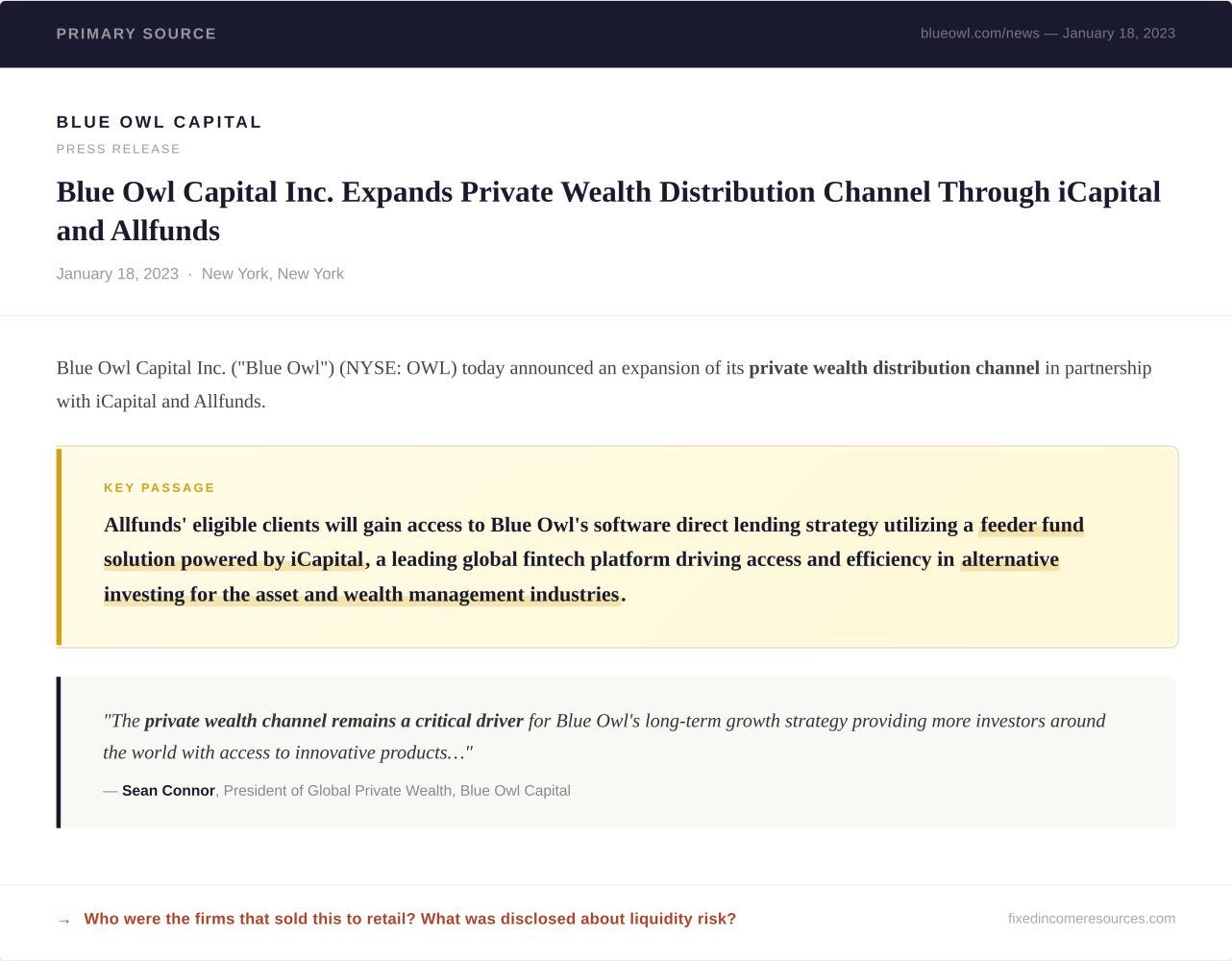
"...a critical driver for Blue Owl's long-term growth strategy..."
Basically: they're looking for retail money, and sure enough they find it.
November 2025: Blue Owl announces a plan to merge OBDC II into OBDC at terms that would cost OBDC II investors roughly 20% (primarily worried about a NAV haircut post deal)
Vote: NDP (deal voted down)
Sometime after voting down the deal, it becomes clear something is seriously amiss, possibly related to liquidity issues, though the specifics aren't public knowledge yet. There have been press reports of growing frustration at OBDC II and other Blue Owl BDCs.
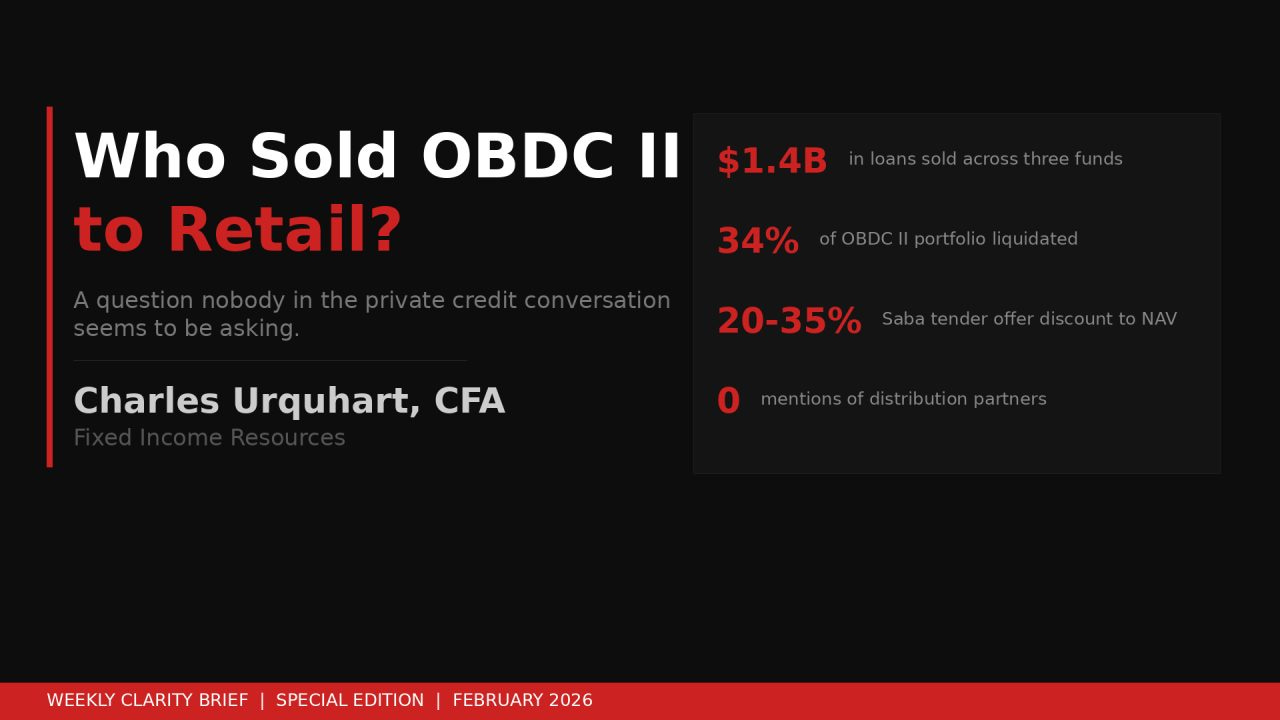
February 18, 2026: Blue Owl announces it has sold $1.4B of loans, including $600M out of OBDC II's portfolio (about 34% of it). The loans went for something near par; the buyers were three North American pension funds and an insurance company. Same day, Blue Owl permanently ends quarterly redemptions on OBDC II. Something they'd never done before. An official statement saying not halting investor liquidity but rather "accelerating the return of capital"
ENTER THE VULTURES
Here's what you need to know: On February 17, a day before Blue Owl's announcement, Saba Capital Management filed a notice with OBDC II of its intention to launch tender offers. They also notified two other Blue Owl BDCs. Saba Capital is run by Boaz Weinstein (one of the sharpest distressed credit traders on the planet). Even more interestingly, Saba Capital's tender offers are at a 20-35% discount to net asset value!
If you haven't guessed yet, this means Weinstein is offering to buy retail investors out at somewhere between 65 and 80 cents on the dollar.
In other words: when you lock people in a (semi)illiquid investment, eventually some vulture swoops in and offers to buy their shares at distressed prices. The result for retail investors: 20-35% losses.
THE QUESTION NOBODY IS ASKING
I'm hearing lots of interesting speculation on how the Blue Owl fiasco will impact the broader private credit space.
Some say: it's a systemic risk.
Some say: it's a media overreaction.
Smart people on both sides. I'm not qualified to referee that debate, and I'm not going to try.
Instead: I have one question.
Who sold OBDC II to retail?
Yes, Blue Owl's January 2023 press release names iCapital as the platform that "powers" distribution into the wealth channel. On a high level, iCapital did what an RIA does for its clients: leveraged client relationships and paid a meaningful selling concession to place a strong product.
And that's just the point: The companies who put retail investors actually into these funds are nowhere to be seen right now.
I've looked through all the shareholder reports I can find. I can't find a single mention of any distribution partner other than iCapital. No previous quarterly statements mention a selling concession.
If you put clients into OBDC II, you know exactly which firm(s) paid meaningful selling concessions. You negotiated these terms, either explicitly or implicitly. You're not going to miss these numbers when you send the updated portfolio breakdown statement.
But guess what: When Blue Owl decided to partner with iCapital, and was apparently not forthcoming about liquidity risk, it basically meant that someone in the wealth channel is going to take a bath. Usually: the smaller the disruption to the distribution chain, the larger the benefit.
My message: if you're involved in private credit distribution, whether calling your own shots or working under someone who does, take a hard look at how products like OBDC II are structured.
Before next time.
WHY THIS MATTERS TO YOUR PRACTICE
Everyone understands how important it is to know the investment strategy / composition of the products you recommend.
Not everyone realizes how important it is to know the terms of liquidity.
Here are some basics you should know about any structured product you recommend:
Terms and conditions for redeeming shares or units
Conditions under which the fund may suspend or permanently halt redemptions
How net asset value is calculated, how often, and by whom
The fund's right or obligation to redeem shares
Policy regarding reinvestment of distributions (if any)
Who your head distributor actually is, and what happens when they jump ship
Of these points, the last one seems especially important in light of OBDC II.
Would you rather be caught with your pants down when your manager screws up, or when your distributor decides this deal isn't worth it anymore?
ONE MORE THING
If you're an advisor reading this and thinking, "I don't fully understand the product structures I'm recommending," or a client is asking you questions about private credit that you can't answer in plain English, that's exactly what I do.
Fixed Income Resources exists to help RIAs get smart on bonds and bond-adjacent products before the phone rings. CE speaking, consulting, or just a conversation about what's actually in the box.
Charles Urquhart, CFA Founder, Fixed Income Resources Adjunct Professor of Finance, Loyola University Maryland
Get Behind the Yield free by email. Short enough to read before your first meeting, specific enough to use in it. Subscribe here.
Need CE hours? Six self-study bond courses, accepted by CFP Board. See the courses.